
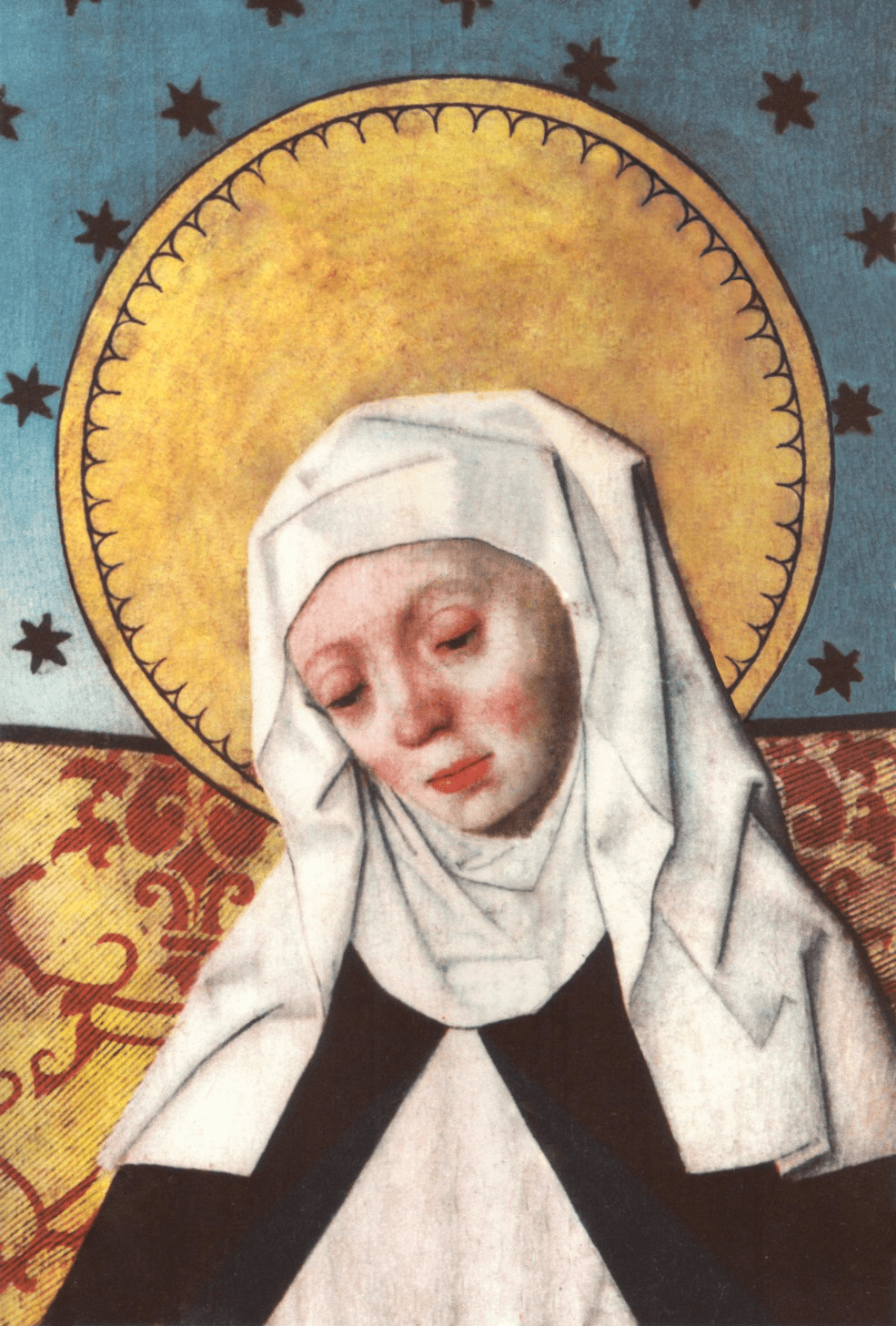
Birgitta Birgersdotter was born to the noble Folkunga family of Uppland, married at thirteen to Ulf Gudmarsson, and bore him eight children — including the future St. Catherine of Sweden. After a pilgrimage to Santiago in 1341–43 the couple took mutual vows of chastity; Ulf entered the Cistercian abbey of Alvastra and died there in 1344, leaving Bridget — at forty-one — a widow.
Her widowhood was the matrix of her great work. She had received mystical visions since childhood; from 1344 they became a continuous and systematic torrent recorded by her two confessors, Master Peter Olofsson of Skänninge and Prior Peter Olofsson of Alvastra, in a vast eight-book Revelationes Caelestes. The visions ranged from intensely personal Christ-and-Mary dialogues (the influential 'Fifteen Prayers' and the 'Birgittine Nativity' iconography that reshaped Western art) to fierce prophetic indictments of corrupt clergy and the Avignon papacy.
In 1349 she left Sweden permanently for Rome, where she lived the remaining twenty-four years of her life — visiting the Holy Land, urging the popes Innocent VI, Urban V, and Gregory XI to return to Rome (her diplomatic alliance with Catherine of Siena across the late 1360s and 1370s was decisive), and founding the new Order of the Most Holy Saviour (the Brigittines), with a unique double-monastery rule combining contemplative women and a small attached community of priests. She died in Rome in 1373; her body was carried back to Vadstena, the great Brigittine motherhouse, the following year. She was canonized in 1391, and named a co-patron of Europe by John Paul II in 1999.