
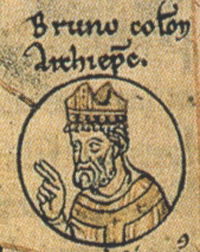
Bruno was born in May 925 — the youngest son of King Henry the Fowler of Germany and Queen St. Mathilda, and brother of Emperor Otto I the Great. Educated at the cathedral school of Utrecht and at the royal Ottonian court chapel, he received the diaconate at age 14 and served as royal chaplain and head of the royal chancery from the early 940s.
On July 21, 953, his brother Emperor Otto I appointed him Archbishop of Cologne — and simultaneously Duke of Lotharingia (the extensive Frankish duchy stretching from the North Sea coast through Lotharingia / Lorraine to the Burgundian Jura). The dual appointment — making Bruno simultaneously the principal Catholic ecclesiastical and principal secular ruler of his extensive territory — is the classic instance of the Ottonian 'imperial church system' (Reichskirchensystem) that produced the distinctive 10th–11th-century Catholic prince-bishop tradition of central Europe.
Bruno reformed the Lotharingian cathedral schools and monasteries — importing the Greek learning, the Cluniac monastic discipline, and the reforming Catholic ascetic culture. He founded the Abbey of St. Pantaleon in Cologne (956) as his principal monastic foundation, and the cathedral school of Cologne that he established became the principal Catholic intellectual centre of 10th-century Germany.
He served as regent during Otto I's absence in Italy for the imperial coronation of 962, and undertook diplomatic missions throughout the Frankish realms — including the mediation between his nephews Lothair and Hugh Capet of West Francia.
He died at Reims on October 11, 965, while on a diplomatic mission, and was buried at his foundation of St. Pantaleon in Cologne, where his shrine remains today.