
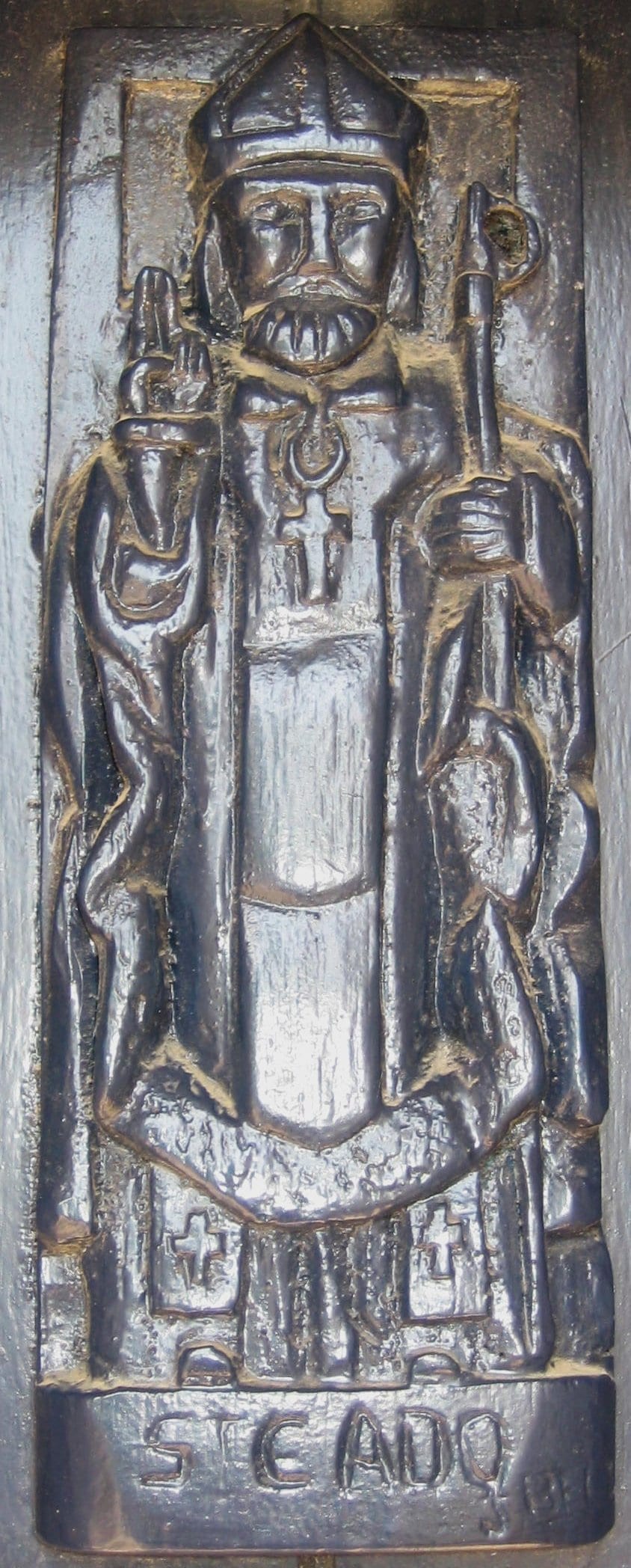
Cadoc (Welsh Cadog Ddoeth, 'Cadoc the Wise'; Latin Cadocus) was — per the foundational 11th-century Vita Sancti Cadoci composed by the Llancarfan hagiographer Lifris — the son of the foundational Welsh saint-king Gwynllyw of Glywysing (modern Newport, southeastern Wales) and Queen Gwladys of Brecknock (both also venerated as Welsh saints). He was raised in the Welsh royal-monastic tradition of southeastern Wales and educated at the foundational Welsh monastic school of Llanilltud Fawr under Illtyd (see Illtyd's entry above).
After his Llanilltud Fawr formation, Cadoc established his own monastic foundation at the small inland Welsh valley of Llancarfan (Welsh Llan Garfan, 'the church of the stag-spring') in the Vale of Glamorgan, around 518 AD. The Llancarfan monastery — the second of the great foundational Welsh monastic-schools after Llanilltud Fawr — became the principal foundation for the next generation of Welsh saints. Across the 6th century the substantial Llancarfan-trained Welsh-Catholic missionaries spread the Welsh monastic-school tradition across South Wales, Cornwall, Brittany, and the Welsh-Irish maritime sphere.
Cadoc travelled extensively to Brittany, Ireland, and possibly to Rome and the Eastern Mediterranean over the course of his long life. The medieval Welsh hagiographic tradition holds that he was eventually killed during an Italian-pilgrimage visit at the small Lombard-period Italian-Lombard court of Beneventum around 580 AD — but the historical reliability of the specific death-tradition is contested. The Welsh continuous cult at Llancarfan has been maintained since at least the 6th century. The medieval Parish Church of St. Cadoc at Llancarfan preserves a substantial surviving 15th-century English-medieval Welsh wall-painting cycle (rediscovered in 2008) of the Llancarfan tradition — one of the most-important surviving early-Christian Welsh-Catholic medieval-art objects.