
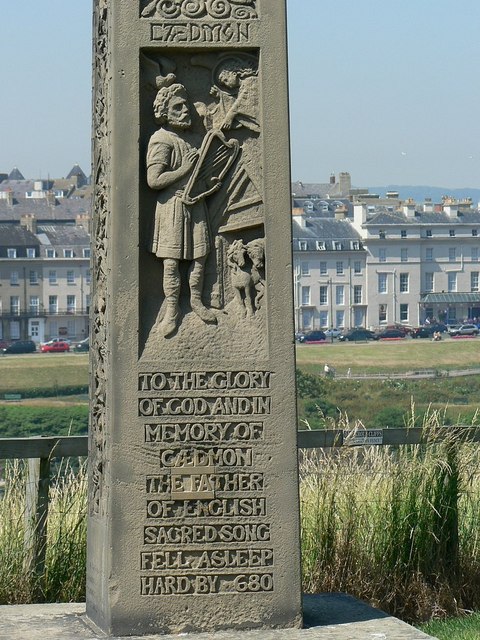
Caedmon was a layman who worked as a cowherd at the monastery of Whitby under St. Hilda. Already an old man, he had so little gift for poetry — the universal entertainment of Anglo-Saxon halls — that when the harp came round at feasts and each guest was expected to sing in turn, he would slip away to the byres to hide his embarrassment.
One night, having so slipped away, he fell asleep in the cattle shed. A man appeared to him in a dream and commanded: 'Caedmon, sing me something.' He replied: 'I do not know how to sing — for that very reason I came out here.' The man said: 'Yet sing.' Caedmon asked: 'What shall I sing?' The man answered: 'Sing of the beginning of created things.' He sang in Old English the nine lines that survive today as Caedmon's Hymn — the oldest surviving Old English Christian poem.
Bede the Venerable preserved the story and the hymn (Eccl. Hist. IV.24). Hilda heard Caedmon recite it the next morning and at once made him a monk. For the rest of his life he turned books of Scripture into Old English verse — Genesis, Exodus, Daniel, the life of Christ, all by his miraculous song. He was the first English Christian poet known by name. He died serenely after asking for the Eucharist in the monastery infirmary, telling the brothers that he could see the doors of heaven opening.