
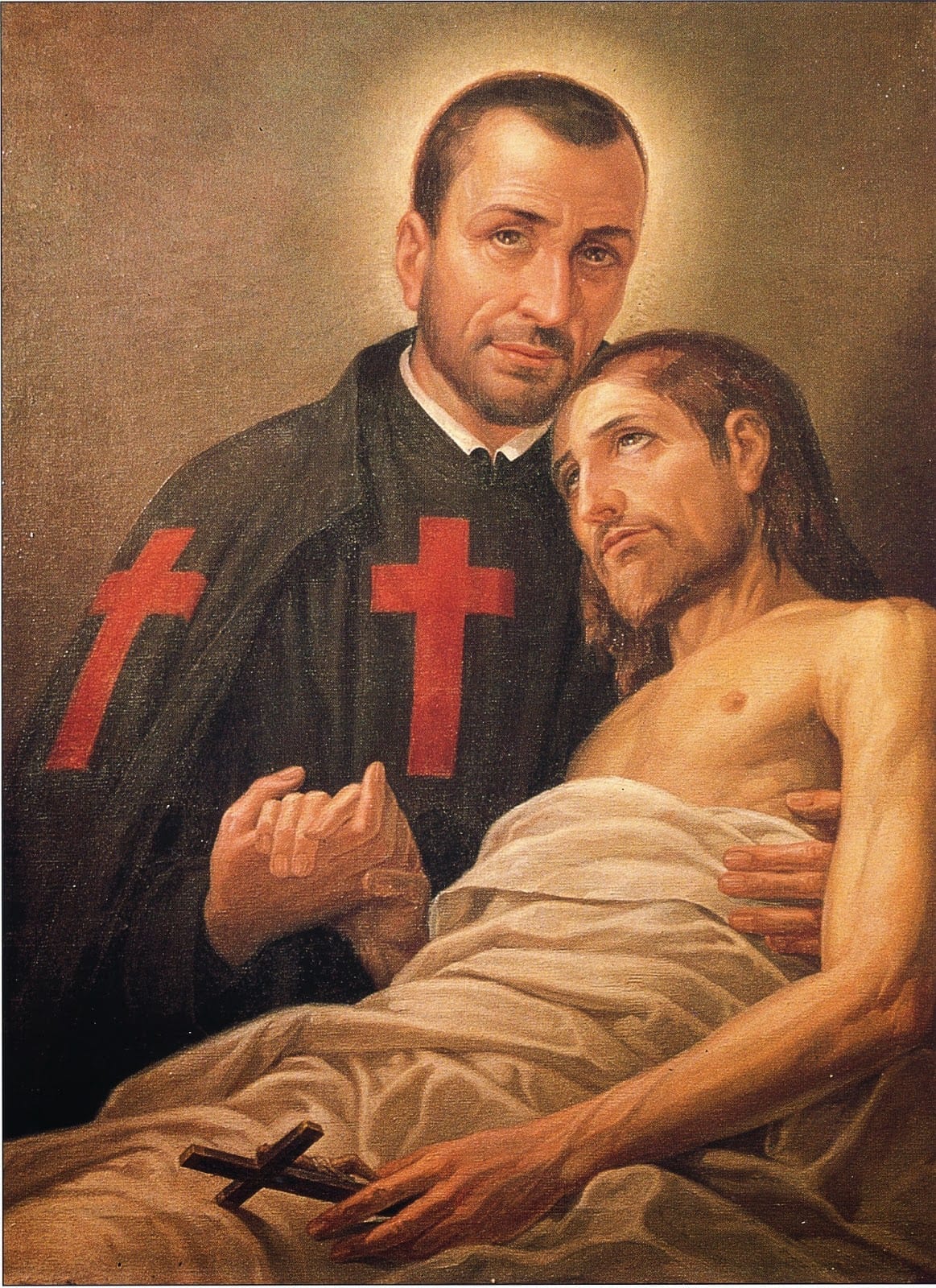
Camillo de Lellis was born in Abruzzo to a family of small local nobility. His mother died when he was thirteen. His father was a mercenary captain in the Spanish army, and Camillus joined him as a soldier at seventeen — fighting in the Venetian-Turkish wars of the 1570s. Tall, fierce, addicted to gambling, he ended his teens and twenties as a poor mercenary with a chronic leg ulcer that would never heal and that prevented his readmission to the Roman hospital of San Giacomo where it had originally been treated.
In 1574, at twenty-four, he was reduced to manual labour at the Capuchin convent of Manfredonia — and there underwent a sudden conversion under the spiritual guidance of the lay brother Father Angelo. He attempted to enter the Capuchins twice; the chronic leg ulcer disqualified him each time. In 1582, then thirty-two, working as servant-administrator at the same San Giacomo hospital where he had once been a patient, he was so horrified by the conditions of hospital care for the poor that he founded, with three companions, the Society of the Ministers of the Sick (the Camillians) — confirmed by Sixtus V in 1591.
The Camillians took a fourth vow beyond the usual three: to serve the sick at the risk of their own lives, particularly in time of plague. They invented the modern hospital uniform — black cassock with a large red cross on the chest (the origin, by direct historical lineage, of the modern Red Cross emblem) — and the systematic methods of hospital sanitation, separate beds, careful charting, and continuous medical-spiritual care of patients that became the standard for early modern Catholic hospitals. Camillus served the great Roman plague outbreaks personally and died at Rome of his own long-untreated illness on July 14, 1614. Canonized 1746.