
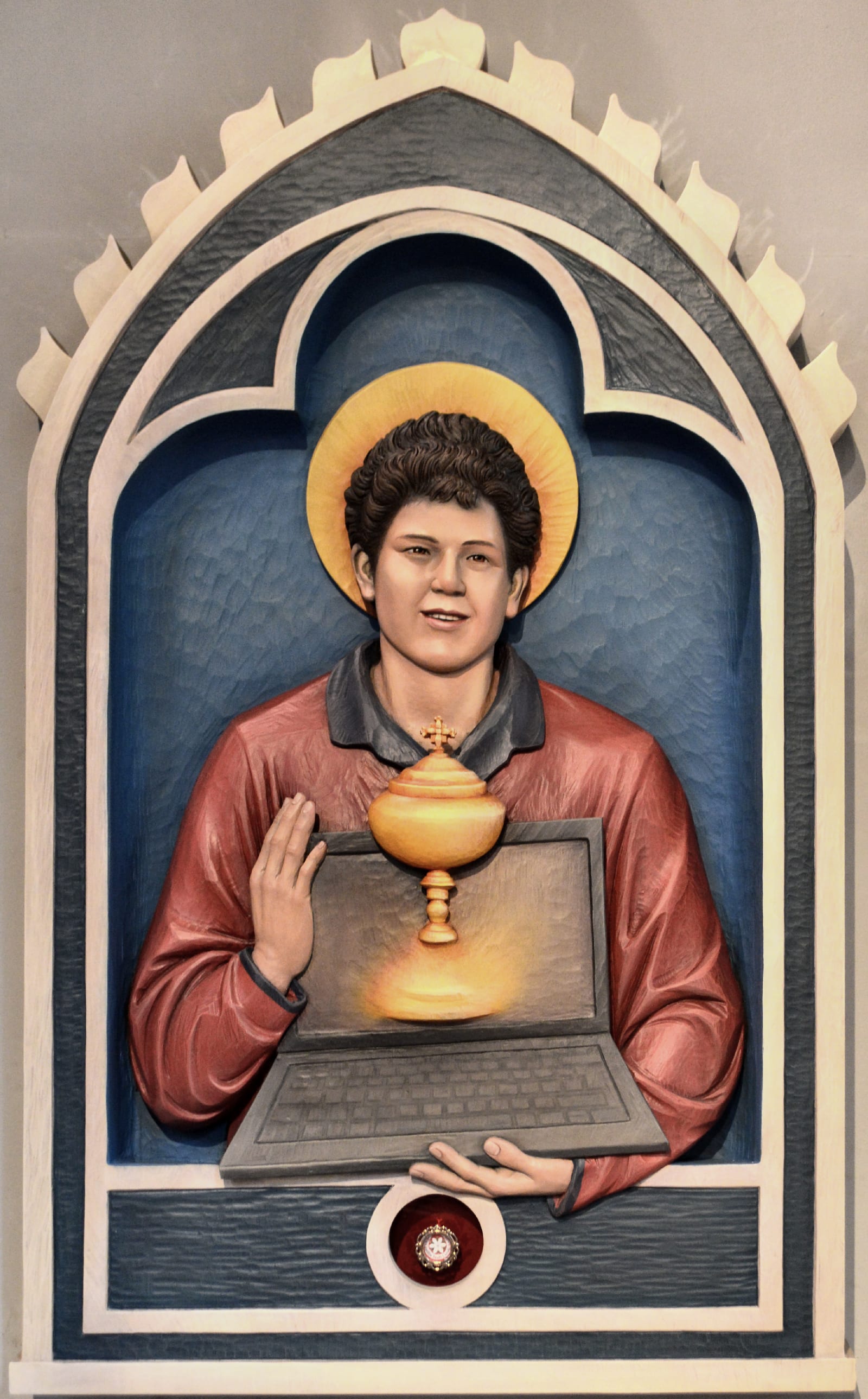
Carlo Acutis was born in London to Italian parents — Andrea and Antonia — on May 3, 1991, and baptised there a few weeks later. The family soon returned to Milan, where Carlo would grow up. His mother, in her own admission, was a non-practising Catholic; it was Carlo, from earliest childhood, who insisted on Mass and brought her back to the faith.
He was an ordinary, much-loved teenager — he played soccer, joked with his friends, edited videos, looked after stray dogs, and was an enthusiastic, self-taught programmer in HTML, JavaScript, Visual Basic, C++, Adobe Photoshop, Dreamweaver, and 3D modelling. He was also, from his First Communion at seven, a daily communicant. He called the Eucharist 'my highway to heaven' and the Rosary 'the most powerful weapon.'
Between the ages of eleven and fourteen, struck by a Eucharistic miracle exhibition he had visited in Rimini, he conceived a vast project: to catalogue every Church-approved Eucharistic miracle in the world on a single website, with photographs, dates, locations, scientific findings, and sources. With his mother as researcher and chaperone, his father funding the travel, and Vatican-recognised theological consultants reviewing the entries, he visited many of the sites in person — Lanciano, Bolsena, Orvieto, Santarém, Cascia, Siena, Walldürn, Daroca — gathering original photographs and primary documentation. The completed catalogue at miracolieucaristici.org documented over 130 Eucharistic miracles from 22 countries spanning more than 1,300 years of Church history.
The catalogue became the basis of the travelling 'Eucharistic Miracles of the World' exhibition — a set of 166 large display panels in identical format, one per miracle, freely available for any parish to download and print. By 2025 it had been shown on all five continents, in over 10,000 parishes, in more than 100 universities, in 22 languages. Cardinal Angelo Comastri (archpriest of St. Peter's) wrote the preface; the Pontifical Academy for Life publicly endorsed the project. The catalogue is the principal reference work for the Eucharistic miracle entries in this app.
Diagnosed in early October 2006 with acute promyelocytic leukaemia (M3), an aggressive form, he offered his suffering 'for the Pope and the Church' and died ten days later at fifteen. He was buried in Assisi, his body vested at his own request in jeans, sneakers, and a Nike tracksuit. Beatified in 2020 and canonised by Pope Leo XIV on September 7, 2025 — the first saint of the millennial generation, with his fellow Italian Bl. Pier Giorgio Frassati canonised at the same Mass.