
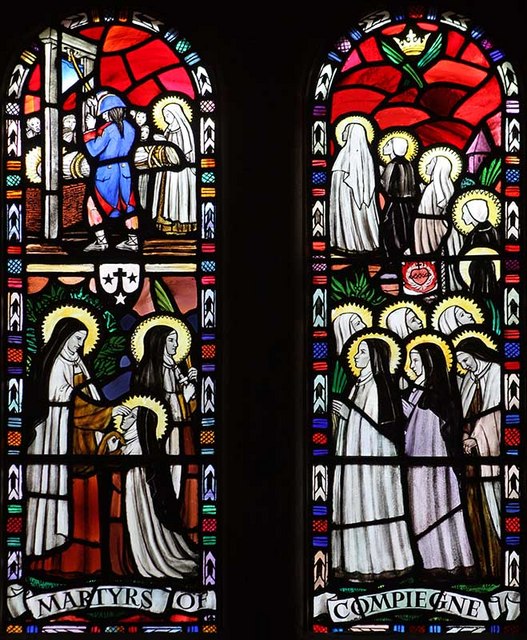
The Discalced Carmelite monastery of Compiègne, founded in 1641 by Madame Acarie's contemporary Madame de Janson, was a foundation of long tradition and pre-Revolutionary respectability. By 1789, when the French Revolution began, the community numbered sixteen — eleven choir nuns, three lay sisters, and two extern (tour-keeping) sisters. Their prioress was Mother Teresa of St. Augustine (Madeleine-Claudine Lidoine), elected in 1786.
From 1790 the National Assembly's Civil Constitution of the Clergy, the requirement of the constitutional oath, and the suppression of all religious orders forced the dissolution of religious houses across France. The Compiègne community was suppressed officially in 1792 and forced to leave their monastery, but the sixteen continued to live in four separate small houses in Compiègne in modest dress — and to maintain their common Discalced Carmelite rule, prayer, and Office in clandestine community. In late 1792 the Prioress Teresa of St. Augustine had each sister make a personal act of consecration: the offering of her own life as substitutionary victim, in union with the Sacred Heart of Jesus, for the restoration of religious peace in France.
They were arrested in late June 1794. Tried at Paris before the Revolutionary Tribunal on July 17, 1794, they were convicted of fanaticism. That same day, in the late afternoon, they were guillotined one at a time at the Place du Trône-Renversé (now Place de la Nation), singing the Salve Regina, the Te Deum, and finally the Veni Creator Spiritus until each successive voice was silenced by the blade. The youngest, Sister Constance of Jesus, was eighteen and had not yet pronounced her perpetual vows; the prioress made her promise vows on the steps of the scaffold and then placed her at the head of the line to be killed first — she went up reciting the Laudate Dominum omnes gentes. Ten days after their death (July 27), Maximilien Robespierre fell in the Thermidorian Reaction and the Reign of Terror ended; their substitutionary offering was understood by their contemporaries (including the surviving Carmelite witness who later wrote their history) as accepted.
Beatified by Pius X in 1906, canonized as a group by Pope Francis on December 18, 2024 — by equipollent canonization, the first collective canonization of French Revolution martyrs since the formal cause was opened over a century earlier. Their story is the subject of Georges Bernanos's posthumous play Dialogues des Carmélites (1949) and of Francis Poulenc's 1957 opera of the same name.