
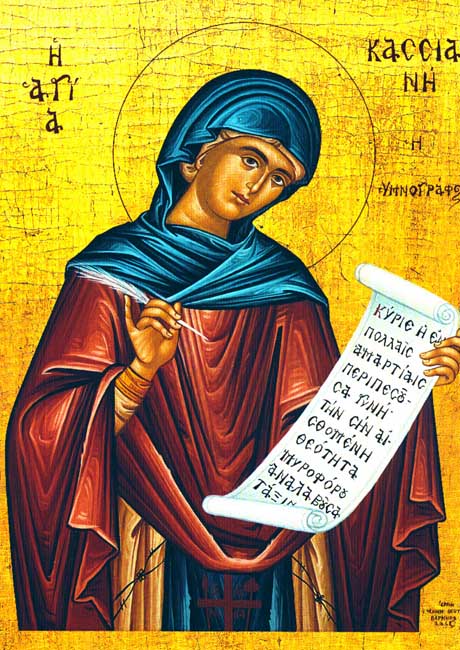
Cassia (also Kassia, Kassiane) was born into a noble Constantinople family. By tradition she was a candidate at the bride-show of Emperor Theophilus in 830 — at which the young emperor was to choose his wife from a parade of the most beautiful and accomplished young women of the empire. Theophilus, attracted to her, approached her and made a remark suggesting that women had brought sin into the world through Eve. Cassia answered: 'Through a woman flowed also things better' — alluding to the Theotokos. Theophilus, taken aback by her wit, turned and offered the golden apple of selection to another candidate.
Cassia entered monastic life, founded a convent at Constantinople around 843, and devoted herself to hymnography. She is the earliest known woman composer in Western history whose music has survived — over thirty of her liturgical hymns are still sung in the Byzantine liturgy, including the Hymn of Kassiane sung at Matins of Holy Wednesday: 'Lord, the woman who fell into many sins, recognizing your divinity, took up the office of myrrh-bearer...' — one of the most beloved compositions of the Orthodox Holy Week.
She continued to write hymns, theological epigrams, and gnomic poems through her long life. She is honored by the Eastern Orthodox Church and by Eastern Catholic Churches as a saint and as the foundational female voice of Byzantine sacred music.