
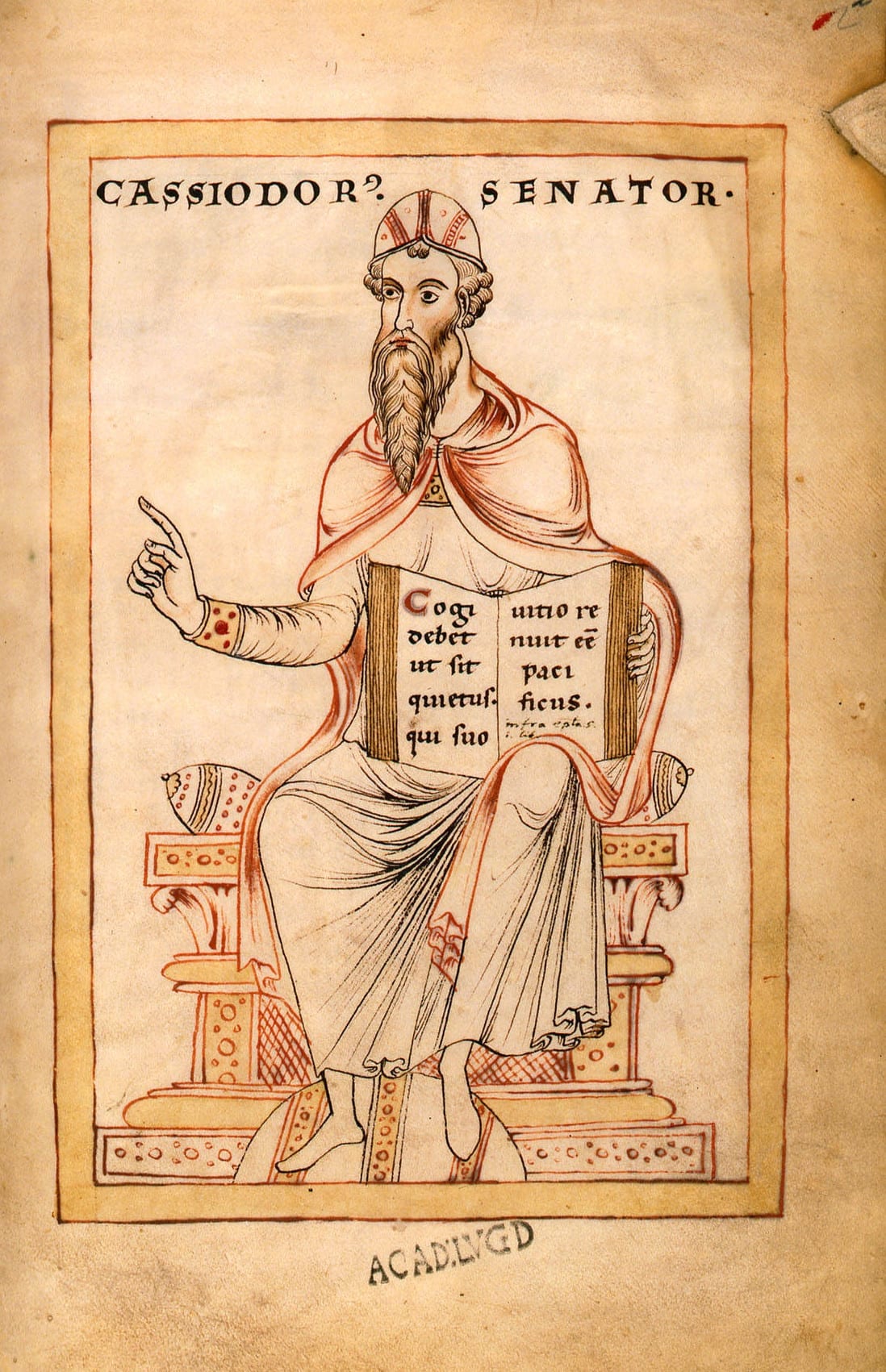
Cassiodorus (Latin Cassiodorus; full name Magnus Aurelius Cassiodorus Senator) was born around 485 AD at Scyllacium (modern Squillace) on the Ionian coast of Calabria, to the great Italian senatorial family of the Cassiodori — the family had served the Roman senatorial administration for several generations and would serve the Ostrogothic-period administration of Italy under the Cassiodori-Theodoric collaboration that would define Cassiodorus's young adulthood.
Cassiodorus served the Ostrogothic Italian administration through a long extraordinary career: Quaestor under King Theodoric (507–512), Consul (514), Master of the Offices (Magister Officiorum, c. 523–527), and ultimately Praetorian Prefect of Italy (533–537) under the successive Ostrogothic kings Theodoric, Athalaric, Amalasuntha, Theodahad, and Vitiges. His twelve-book Variae — the surviving collection of official letters and edicts of the Ostrogothic Italian administration — is one of the most important historical sources for the late-Roman-to-Ostrogothic transition in Italy.
Around 537 — at the catastrophic collapse of the Ostrogothic administration during the Justinianic-Gothic War — Cassiodorus retired from public administration. He attempted with Pope Agapitus I (see Agapitus's entry above) the project of establishing at Rome a substantial Catholic-Christian scholarly library (modelled on the great Catechetical School of Alexandria), but the project was overtaken by the catastrophic war.
Around 554 AD — at the end of the long Gothic War — Cassiodorus retired to his family estates at Scyllacium in Calabria, where he established the great Vivarium Monastery (so named for the small fishponds — vivaria — adjacent to the monastery site on the Calabrian Ionian coast). The Vivarium became one of the early-medieval Catholic-Christian scholarly-monastic centres — and the example of the systematic Catholic-monastic combination of contemplative-monastic life with substantial scholarly-textual work (the model that would be transmitted through the medieval Benedictine tradition into the universal medieval Western Catholic monastic-scholarly tradition).
Cassiodorus directed at Vivarium across the next three decades the substantial project that is his principal historical importance: the systematic collection, copying, and preservation of the substantial Latin and Greek classical-Christian textual heritage at the very moment of the catastrophic collapse of the Western Roman civic-educational infrastructure. His Institutiones Divinarum et Saecularium Litterarum (the 'Institutes of Divine and Secular Learning,' c. 562 AD) — the early-medieval Catholic-Christian library-classification handbook — became the medieval handbook of monastic-library scholarship. The substantial textual collection and copying-tradition he established at Vivarium preserved into the medieval period much of the Latin-Christian patristic textual heritage that would otherwise have been lost in the catastrophic 6th-century Western collapse.
He died at Vivarium around 585 AD at approximately 100 years of age (the extreme longevity is well-attested in the contemporary sources). The substantial Vivarium textual collection was dispersed across the medieval Western monastic libraries after his death — particularly through the early-medieval Benedictine system. He is the figure of Latin-Christian scholarship through the dark ages.