
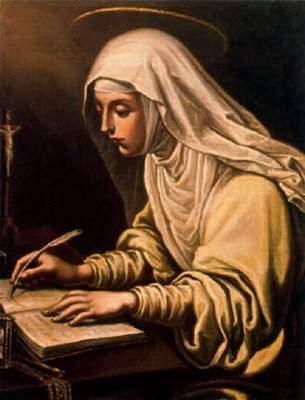
Alessandra Lucrezia Romola de' Ricci was born to the great Florentine banking family of the Ricci and entered the Dominican convent of San Vincenzo Ferreri at Prato at thirteen in 1535 — the small Tuscan reform house founded a few years earlier by disciples of Savonarola of San Marco. She took the religious name Caterina. She served as novice-mistress (1552), then sub-prioress, then perpetual prioress from 1560 — an office she held for over thirty years until her death.
Her mystical life began at twenty in 1542 with the first of a long series of weekly Passion ecstasies — each Thursday at noon until 4pm Friday, for over twelve consecutive years (1542–54), she relived in physical experience the Passion of Christ from the Agony in the Garden through the Crucifixion, with the visible stigmata of the Five Wounds and the Crown of Thorns appearing during each weekly cycle. The phenomena were documented under independent observation by her Dominican spiritual directors and her physician Andrea Pasquali, and produced an extraordinary throng of medical, theological, and devotional visitors to the small convent at Prato.
She also received in this period — and across the rest of her life — a series of mystical visions of the figures of her own age. The most famous: in May 1554 she was visited at Prato by St. Philip Neri (whom she had never previously met physically and who was then in Rome — see his entry in the 16th-c. catalogue); the historical record contains the testimony of multiple witnesses to the meeting. The phenomenon was treated by the church authorities as one of the most extensively-attested cases of bilocation in early modern Catholic hagiography. She corresponded with multiple major figures of the Catholic Reformation including Charles Borromeo and the Florentine reformer Cosimo de' Medici. She died at Prato on the feast of the Purification, February 2, 1590. Canonized 1746.