
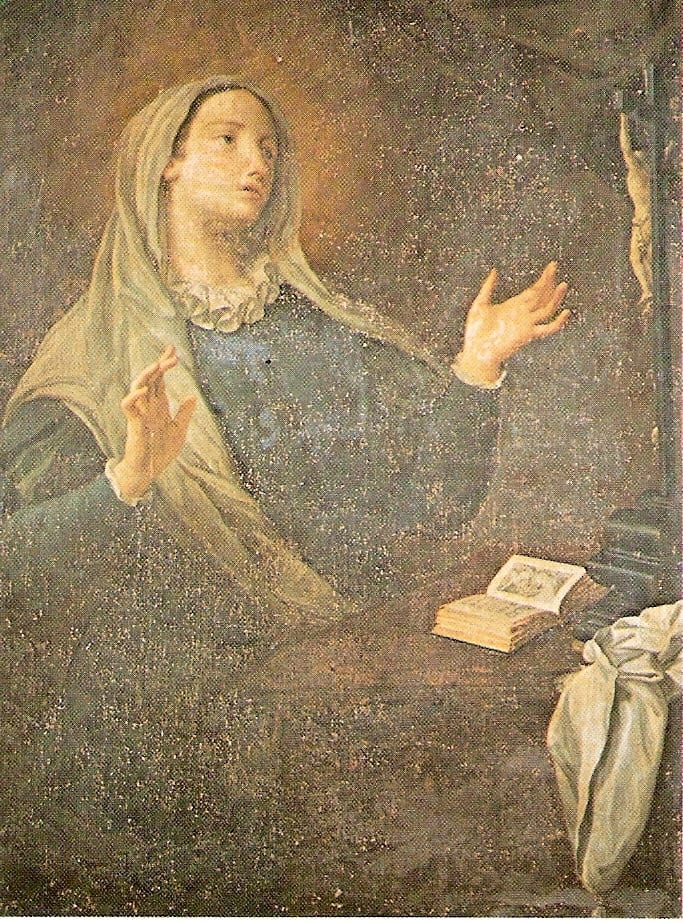
Caterinetta Fieschi was born to the great Fieschi family of Genoa — a niece of Pope Innocent IV and great-niece of Pope Adrian V — and at sixteen was married for political reasons to Giuliano Adorno of the rival Adorno family. The marriage was a disaster: Giuliano was unfaithful, spendthrift, and drove the family into financial collapse. Catherine, who had wished to enter religion, endured ten years of deep depression and worldliness as a Genoese noblewoman.
On March 22, 1473 — a confession before a Genoese priest — she received a sudden mystical illumination of God's love and of her own sinfulness so intense that she had to be physically supported home. The vision transformed her permanently. She abandoned all society, dedicated herself entirely to caring for the poorest sick at the great Genoese hospital of Pammatone (taking complete charge of it from 1490 to 1496 as administrator), and converted her broken husband, who joined her work as a Franciscan tertiary at the hospital. The plague years of 1493 (when four-fifths of Genoa died) and 1501 became the matrix of her hospital work and her mystical writing.
Her two books — the Trattato del Purgatorio and the Dialogo tra l'Anima e il Corpo — are foundational late-medieval texts. The Treatise on Purgatory presents purgatory not as a place of judicial punishment but as the soul's burning experience of God's pure love — a love that consumes whatever in the soul is opposed to it. The work has been continuously influential on Catholic eschatology since: Bossuet, Newman (whose Dream of Gerontius adapts her vision), Ratzinger (who treats her at length in his Eschatology), and her recent commentators trace a direct mystical line from her Trattato to the catechetical treatment of purgatory in Catholic theology today. She died at Genoa on September 15, 1510. Canonized 1737.