
MIRACULOUS MIRACLES™

Saint — Catherine of Siena

St. Catherine of Siena
March 25, 1347 — April 29, 1380
Doctor of the Church — Patron of Italy and Europe
Basilica of San Domenico, Siena, Italy
Feast
April 29
Canonized
June 29, 1461 (by Pope Pius II)
Doctor of the Church
Yes
Life

Catherine Benincasa was the twenty-third (or twenty-fifth — accounts vary) of a wool-dyer's twenty-five children. At six or seven, walking with her brother, she had her first vision of Christ enthroned. She made a private vow of virginity at seven, resisted her family's plans to marry her by cutting off her hair, and at sixteen entered the Dominican Third Order — laywomen living a religious life at home.

For three years she shut herself in a small room in her parents' house, leaving only for Mass and confession. The trial ended with a vision of mystical espousal to Christ — she received a ring visible only to herself. She then emerged to a vigorous public life: nursing plague victims and lepers, gathering disciples around her, dictating hundreds of letters to popes, princes, and ordinary souls (she may have been functionally illiterate most of her life), and intervening boldly in Church politics.

Her greatest political work was persuading Pope Gregory XI to return the papacy from Avignon to Rome in 1376 — ending the seventy-year 'Babylonian Captivity' of the popes. After the Western Schism erupted in 1378 she went to Rome to support Pope Urban VI, dictating her great mystical work The Dialogue. She died there in 1380, aged thirty-three.

She was canonised by Pius II in 1461. In 1970, Paul VI declared her a Doctor of the Church — the second woman so named, with Teresa of Ávila. John Paul II named her a co-patron of Europe in 1999.

Miracles & Phenomena
  • The Mystical Marriage

    c. 1366

    At the end of her three-year enclosure, Catherine received a vision in which Christ took her as His mystical bride before His mother, with David and Paul as witnesses. He gave her a ring visible only to herself, which she said she felt on her finger for the rest of her life.

  • The Invisible Stigmata

    1375, Pisa

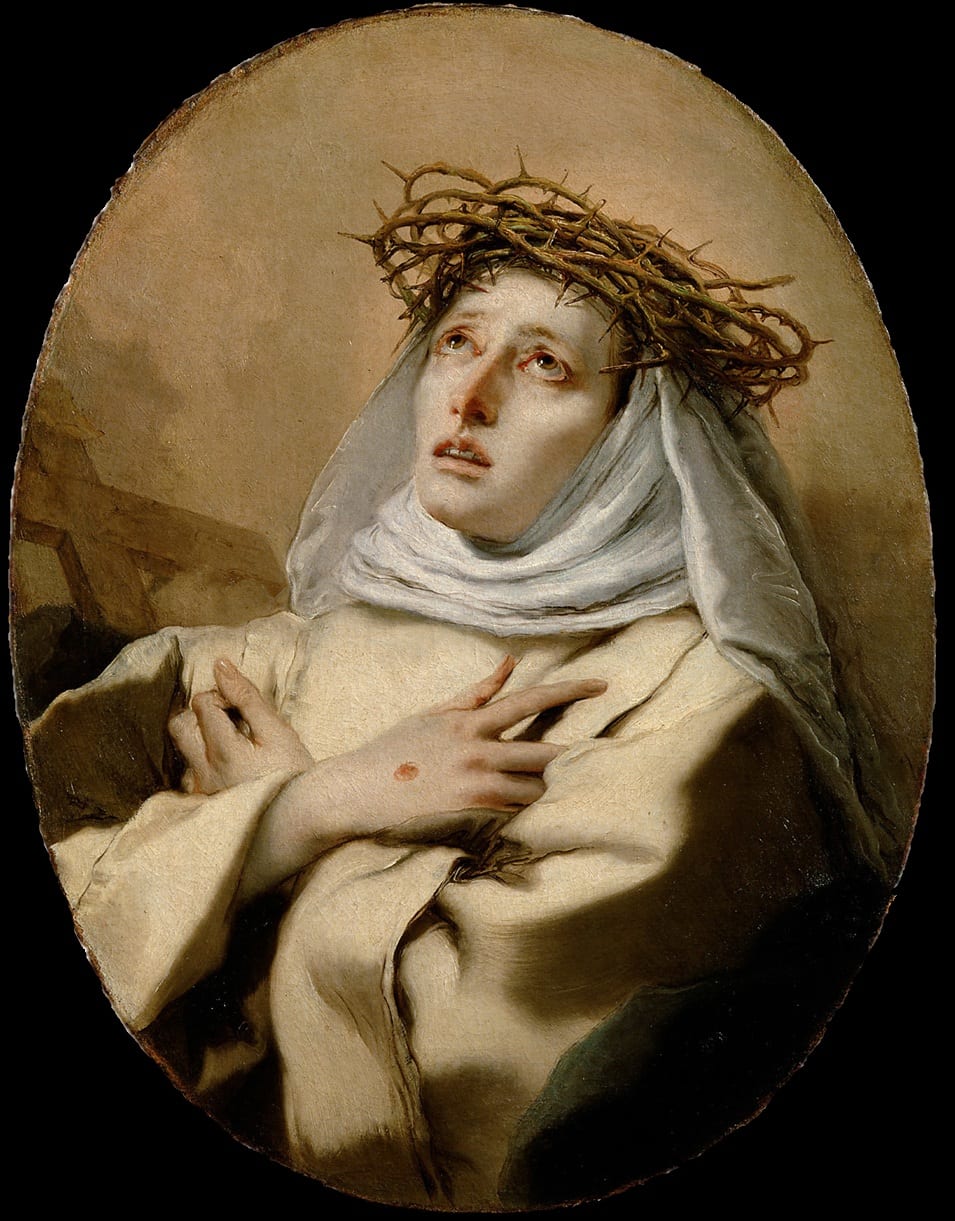
    Praying before the crucifix at the Church of Santa Cristina in Pisa in 1375, Catherine received the wounds of Christ. At her own request, the wounds remained invisible during her lifetime — only their pain. Witnesses testified that the wounds became visible after her death.

  • The Exchange of Hearts

    In one of her best-known visions, Christ removed her heart and replaced it with His own. The Dialogue and her letters speak repeatedly of living thereafter 'with the heart of Christ.'

  • Inedia and the Eucharist

    From her late twenties, Catherine reportedly subsisted on almost nothing but the Eucharist for years at a time. The phenomenon was investigated and accepted at her canonisation process.

Relics
  • Bodily relic
    Incorrupt head of St. Catherine
    Basilica of San Domenico, Siena

    Detached from her body in 1381 at the wish of Pope Urban VI; received with a great procession in Siena in 1385 and displayed in a gold reliquary ever since.

  • Body
    Body of St. Catherine
    Santa Maria sopra Minerva, Rome

    Beneath the main altar of the great Dominican church in Rome where she died.

  • Bodily relic
    Right thumb
    San Domenico, Siena
  • Bodily relic
    Left foot
    Santi Giovanni e Paolo, Venice
Iconography
  • The Mystical Marriage of St. Catherine of Siena
    Lorenzo Lotto, Beccafumi, Tiepolo, and others

    Catherine receives a ring from the Christ Child held by His mother — one of the great themes of Counter-Reformation and Baroque painting.

  • St. Catherine with a Lily and a Book

    Standard attributes: lily for virginity, book for The Dialogue, stigmata visible on her hands, often a crown of thorns.

Prayers Composed by This Saint
Patronages
Italy (co-patron with St. Francis)Europe (co-patron)Rome (co-patron)NursesFirefightersAgainst miscarriageAgainst sexual temptationPeople ridiculed for their piety
Sources & Further Reading