
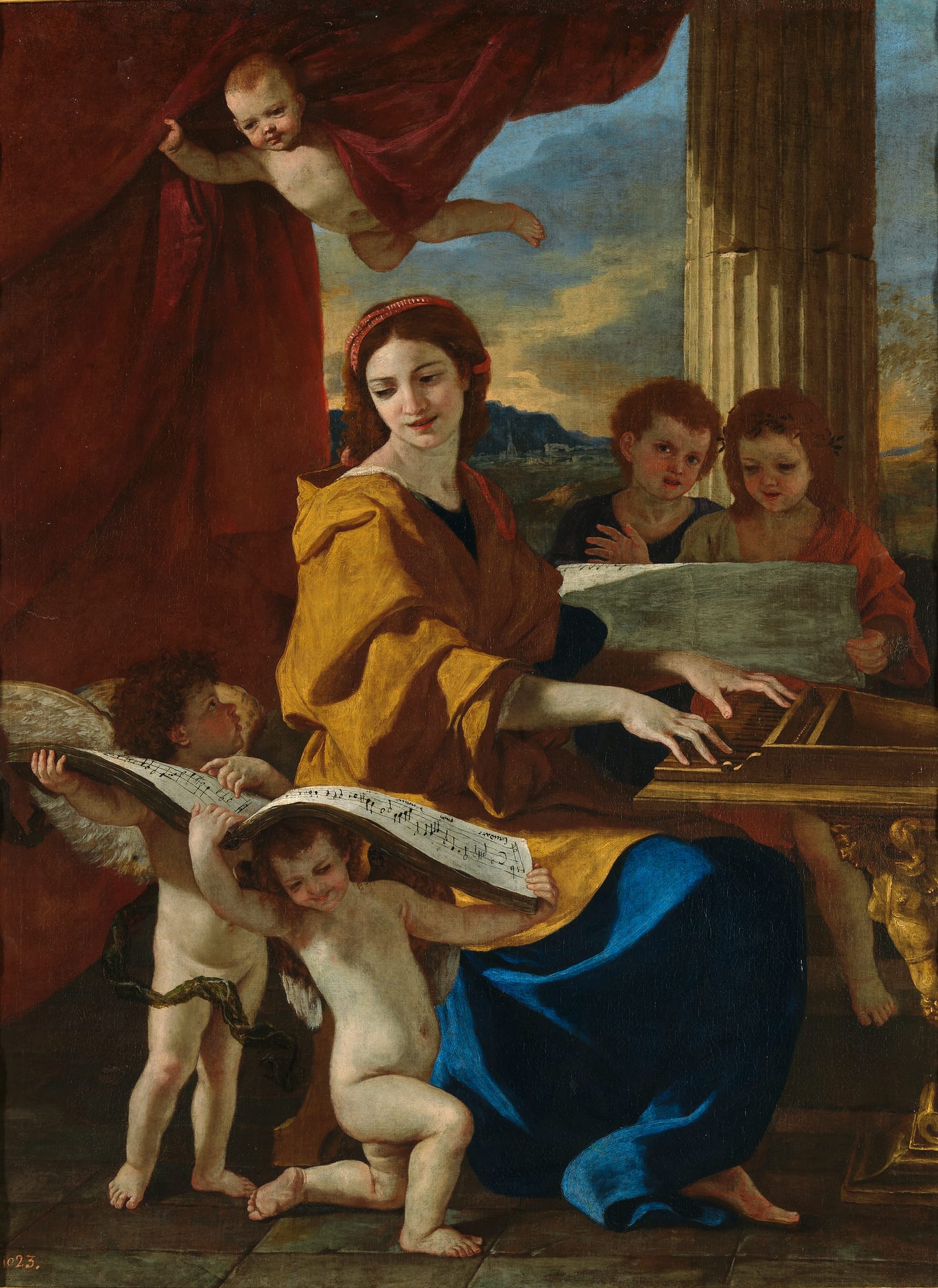
Cecilia was — per the universal Roman tradition first attested in the late-4th-century Acts of St. Cecilia and continuously venerated since — a young Roman patrician virgin of the noble Caecilii Metelli family, who from childhood had privately consecrated her virginity to Christ. Her parents arranged her marriage to a young pagan Roman noble named Valerian. On the wedding night Cecilia revealed to Valerian her vow and her angel-guardian, and asked him to respect her consecrated virginity. Valerian asked to see the angel; Cecilia replied that he would see the angel if he received baptism. He went to Pope Urban I (or — in earlier datings — to an unspecified Roman bishop) at the catacombs, received baptism, and returned to find Cecilia in conversation with the angel, who placed two crowns of lilies and roses on their heads. Valerian's brother Tiburtius was converted at the same encounter.
All three were eventually arrested by the Roman prefect Almachius. Valerian and Tiburtius were beheaded; Cecilia was condemned to be suffocated in the hot vapours of her own villa's bath-room. After a day and a night of attempted suffocation she remained unharmed; the prefect then sent an executioner to behead her. He struck her three times with the sword (the legal maximum permitted by Roman judicial procedure) but failed to sever the head from the body. She lived three days in this state, distributing her property to the Roman poor and asking the Roman bishop to convert her villa into a Christian church before she died.
Her villa was indeed converted into a church — the great Basilica of Santa Cecilia in Trastevere, which stands on the same site. In 1599 the tomb was opened during a restoration; Cecilia's body was found incorrupt, lying on her right side with her face turned to the floor and her three sword-cuts visible at her neck. The sculptor Stefano Maderno was present and sculpted from direct observation the famous marble Cecilia of 1600 — which lies beneath the high altar of the basilica to this day, representing exactly the posture of the body. She is one of the seven women specifically named in the Eucharistic Canon of the Roman Mass.