
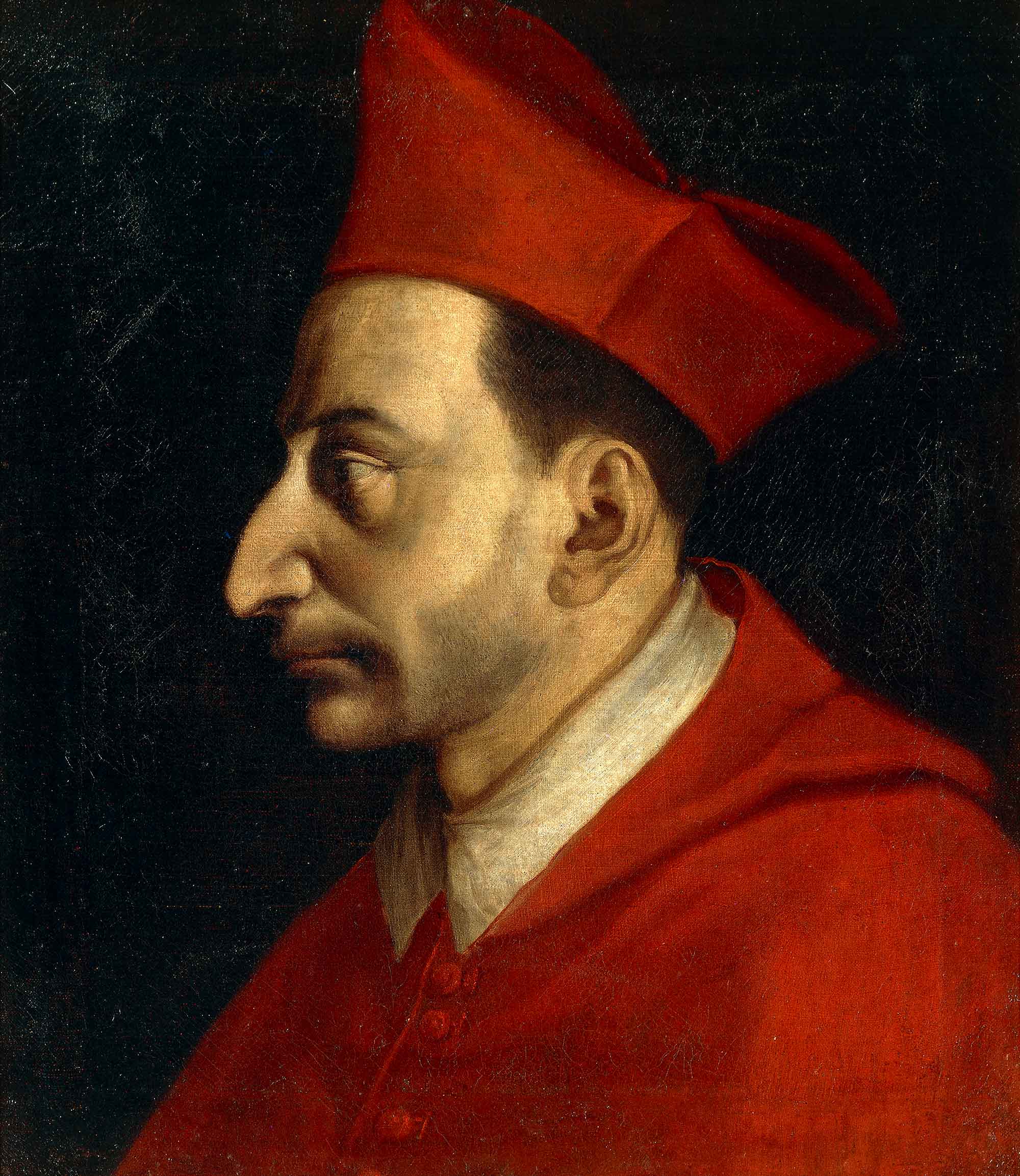
Carlo Borromeo was the second son of Gilberto II Borromeo and Margherita de' Medici (the elder sister of the future Pope Pius IV). Tonsured as cleric at twelve, he received the abbey of Sts. Gratinian and Felinus near Arona as a benefice the same year. Studies at Pavia produced a doctorate in canon and civil law in 1559 — the year his uncle was elected Pope Pius IV.
Pius IV summoned him to Rome and within twelve months created him cardinal (January 1560, aged twenty-two), Archbishop of Milan (February 1560), and Secretary of State — the most spectacular preferment of any nepot-cardinal in the Renaissance papacy. But Charles, against type, was transformed by his uncle's confidence. He effectively ran the curia for four years, restored the Council of Trent (suspended for ten years, reconvened in January 1562, concluded in December 1563), and — after the death of his older brother in 1562 — refused political-secular life despite his uncle's pressure, was ordained priest in 1563, and dedicated himself to the new Tridentine reform.
He took up actual residence at Milan in 1566 (the first archbishop to do so in eighty years) and remained there until his death eighteen years later. His tenure made Milan the model diocese of the Counter-Reformation: he held twelve diocesan and provincial synods, founded the first Tridentine seminary (Pavia 1564, the model for all subsequent Catholic seminaries), the Confraternity of Christian Doctrine for the catechesis of children (the basis of the modern parish CCD), and dozens of charitable institutions; he personally toured the diocese on foot at every visitation, faced down resistant noble families, survived an assassination attempt in 1569 (a Humiliati monk fired an arquebus at him at vespers — the bullet was deflected by his cope), and during the Milan plague of 1576–78 famously walked through the city in penitential procession with the relic of the Holy Nail of Milan, ministering personally to the sick and the dying. He died at Milan, exhausted, on November 3, 1584, aged forty-six. Canonized 1610.