
MIRACULOUS MIRACLES™

Saint — Charles de Foucauld

St. Charles de Foucauld
September 15, 1858 — December 1, 1916 (murdered at Tamanrasset)
Universal Brother — hermit of the Sahara
Hermitage at Tamanrasset, Hoggar Mountains, Algeria
Feast
December 1
Canonized
May 15, 2022 (by Pope Francis)
Beatified
November 13, 2005 (by Benedict XVI)
✠ MartyrShot dead by a marauding Senusi band at his hermitage in Tamanrasset, December 1, 1916 → The Martyrs
Life

Charles-Eugène de Foucauld de Pontbriand was born in Strasbourg to one of the great Catholic noble families of France. Orphaned at six and raised by his maternal grandfather (a colonel), he lost his faith in adolescence and entered the military academy of Saint-Cyr — graduating near the bottom of his class as a notorious idler and bon vivant. He served as a cavalry officer in Algeria, was expelled for taking his mistress with him as 'Madame Vicomte de Foucauld,' resigned his commission, and undertook a remarkable solo geographical expedition into Morocco in 1883–84 disguised as a Russian Jewish rabbi (the country was forbidden to Christians). His Reconnaissance au Maroc won him gold medals from the French Geographical Society.

Returning to France he experienced a profound reconversion. In the church of St. Augustin in Paris in October 1886 he asked a holy priest (Fr. Henri Huvelin) to hear his confession — Huvelin instead made him receive Communion. From that moment Foucauld was transformed. He entered the Trappists in 1890, was professed, asked for and obtained transfer to a more austere Syrian Trappist house, then left to live as a hermit-servant at the Poor Clare convent at Nazareth (1897–1900), then was ordained priest at Viviers (1901) and immediately requested permission to serve the Tuareg people of the Sahara as a hermit.

From 1901 until his death in 1916, Charles de Foucauld lived alone — first at Beni Abbès on the Algerian-Moroccan border, then from 1905 at the remote Tuareg town of Tamanrasset in the Hoggar mountains. He made no converts. He compiled the first French-Tuareg dictionary (a four-volume scholarly work still in use). He served the sick, ransomed slaves, and offered his life in silent friendship for the salvation of the people among whom he lived.

He was shot dead by a marauding Senusi band on December 1, 1916 in his small mud-walled hermitage at Tamanrasset. He had no living disciples. His writings, dispersed by friends in France over the following decades, slowly generated the religious families of the Little Brothers of Jesus (1933) and Little Sisters of Jesus (1939) — now spread across the world. Beatified 2005; canonised by Pope Francis on May 15, 2022.

Miracles & Phenomena
  • Cure of Charle Krempl (beatification miracle)

    1984

    A 49-year-old French metal-worker dying of bone cancer was cured suddenly in 1984 after his wife prayed at Foucauld's place of martyrdom. Accepted as the beatification miracle in 2005.

  • Cure of a French carpenter (canonisation miracle)

    2016

    A young French carpenter, declared brain-dead after a serious accident in Saumur in 2016, recovered suddenly without explanation after prayer through Charles de Foucauld's intercession. Accepted as the canonisation miracle in May 2020.

  • The Slow Posthumous Foundation of his Religious Families

    Charles died with no companions and no disciples. The Little Brothers of Jesus (1933) and Little Sisters of Jesus (1939) — religious families based directly on his Rule — were founded over a decade after his death by people who had read his writings. They are now established in over fifty countries, particularly in the Islamic world.

Relics
  • Body
    Tomb of St. Charles de Foucauld
    El Goléa (modern El Menia), Algeria

    His body was translated from Tamanrasset to a small grave at El Goléa in central Algeria in 1929. The site is a quiet pilgrimage destination in the Sahara — accessible only by long desert journey.

  • Object
    Manuscripts and personal effects
    Tamanrasset hermitage (preserved); Notre-Dame des Armées (Versailles)
Iconography
  • Charles in the White Tunic with Red Heart

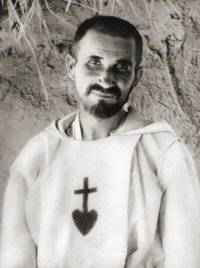
    His invariable image — a thin, ascetic figure in the white wool tunic he designed for himself, with a red heart surmounted by a small cross sewn over the chest. He died wearing this tunic. It is now the habit of the Little Brothers and Sisters of Jesus.

Patronages
The SaharaHermits and contemplativesMission to MuslimsThe Little Brothers and Little Sisters of Jesus
Sources & Further Reading