
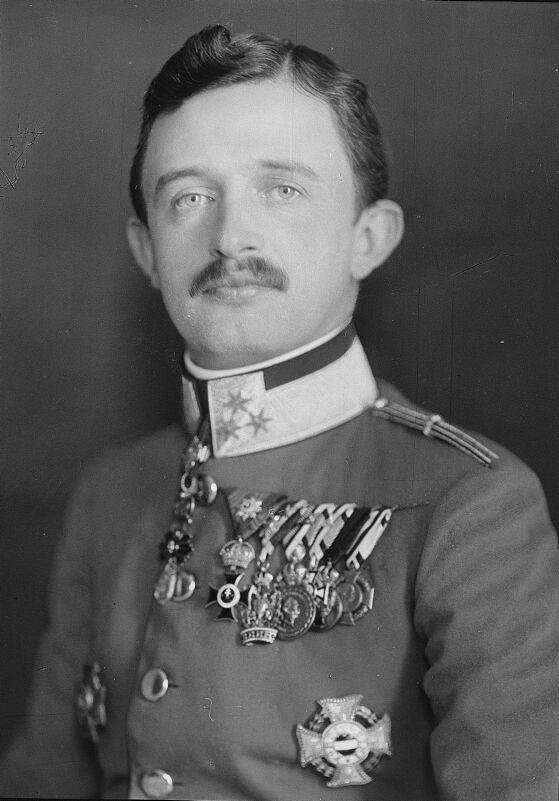
Karl was born on August 17, 1887 at Persenbeug Castle to the House of Habsburg-Lorraine. In 1911, at the age of 24, Karl married Princess Zita of Bourbon-Parma at the Schwarzau Castle — the Catholic royal-devotional marriage.
Following the June 28, 1914 assassination of Archduke Franz Ferdinand at Sarajevo (triggering the First World War), Karl became the heir to the Austrian-Hungarian throne. On November 21, 1916, on the death of Emperor Franz Joseph I, Karl succeeded as Emperor Charles I of Austria and King Charles IV of Hungary.
Karl became famous during his two-year reign (1916–1918) for the systematic Catholic peace-seeking efforts — the Sixtus Affair (1917–1918), the secret peace negotiations with France conducted through Karl's Bourbon-Parma brother-in-law Prince Sixtus. Karl became the only Central-Powers monarch to actively seek separate peace during World War I.
In November 1918, following the Austro-Hungarian defeat and the systematic collapse, Karl renounced participation in government but refused to abdicate. From 1919 to 1921, Karl and Zita lived in exile in Switzerland. In 1921, Karl attempted two restorations of the Hungarian throne — both suppressed by Admiral Miklós Horthy.
Exiled to Madeira in November 1921, Karl died at Funchal on April 1, 1922 of pneumonia at the age of 34 — leaving Zita widowed with eight children.
Beatified October 3, 2004 by Pope St. John Paul II — the 21st-century papal recognition of Karl's Catholic peace-seeking witness.