
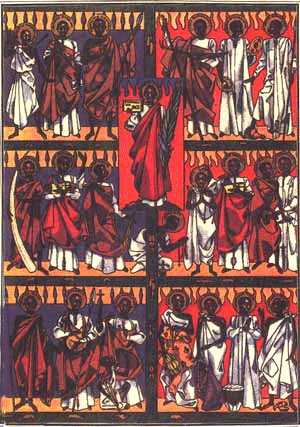
Charles Lwanga was a young Muganda of the Ngabi clan, athletic, capable, and quickly promoted at the court of Kabaka Mwanga II of Buganda, where he became master of the royal pages. He had learned the faith from the White Fathers' missions and from the martyred royal steward Joseph Mukasa Balikuddembe; on the night Mukasa was beheaded in November 1885, Lwanga sought baptism, and for the six months that remained to him he stood between the adolescent pages in his charge and the violent demands of the king — instructing them in the faith and protecting them from Mwanga's predations.
On May 25, 1886, the storm broke: Mwanga, enraged that the pages were being catechized and would not comply with him, resolved to destroy the Christians of his court. Lwanga secretly baptized four of his catechumens that night. The next morning the king assembled the court and ordered the Christians to separate themselves; Lwanga led fifteen young men, most under twenty-five, to stand apart. Asked whether they intended to remain Christians, they answered, 'Until death.'
They were marched two days to the execution place at Namugongo and held for a week while the pyre was prepared. On the feast of the Ascension, June 3, 1886, Charles Lwanga was singled out for a crueler death: wrapped tightly in reed mats, he was laid on the pyre and burned slowly from the feet, his executioners taunting him to let his God rescue him. He is recorded to have answered quietly, 'You are burning me, but it is as if you are pouring water over my body,' and to have died calling on the name of Jesus. Twelve companions were burned together in a single great pyre the same morning; in all, twenty-two Catholic martyrs of Uganda died between 1885 and 1887, with a company of Anglican converts who died alongside them.
Paul VI canonized the twenty-two in 1964 before the assembled Second Vatican Council — the first canonization of sub-Saharan African saints of the modern era — and in 1969 became the first reigning pope to set foot in Africa, consecrating the altar of the Namugongo shrine. The annual June 3 pilgrimage to Namugongo now draws millions from across East Africa, among the largest Christian gatherings in the world.