
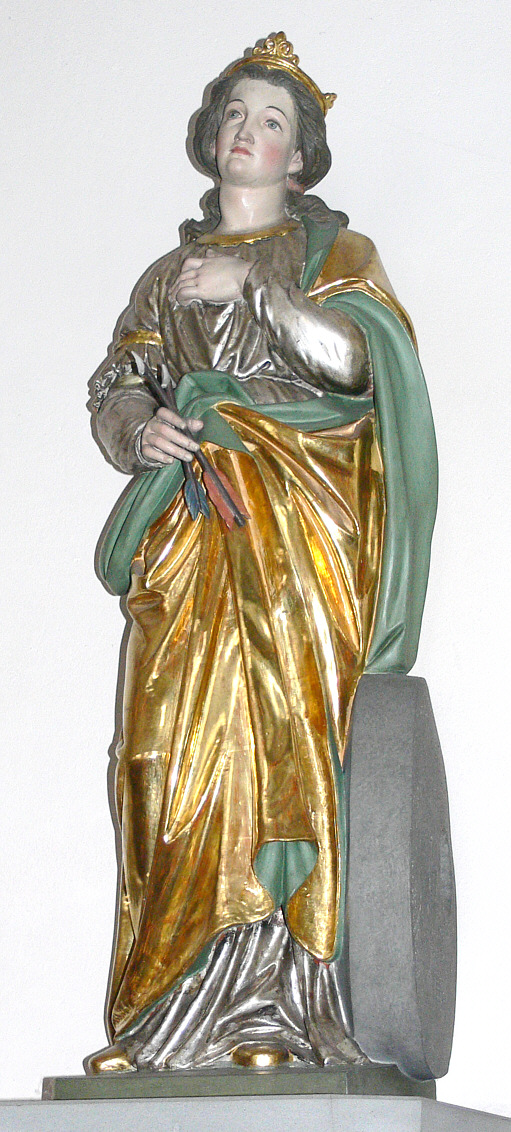
Christina (Latin Christina, 'follower of Christ') was — per the substantial Latin tradition preserved at Bolsena since at least the 4th century — a noble Roman virgin of the small Etruscan-Roman lake town of Bolsena (Latin Volsinii Novi) on the great volcanic lake of Bolsena in central Lazio. Her father Urbanus was the Roman magistrate of the town and a fervent pagan; he had her raised in privileged isolation in a great house with golden idols.
Christina, secretly converted to Christianity at twelve, broke the idols in her father's house and distributed the gold to the poor. Her enraged father had her tortured by a sequence of progressively more brutal Roman judicial methods: she was scourged, broken on the wheel, thrown into a furnace (where she remained unharmed for five days), bound to a rock and thrown into the lake (whence she was preserved by the Archangel Michael), thrown to vipers (which did not bite her), had her tongue cut out (which she nonetheless used to throw the severed tongue back at the magistrate, blinding one eye), and was finally killed by being shot through the heart with two arrows. The site of her execution on the lakeshore is preserved at the basilica of Santa Cristina at Bolsena.
The famous 1263 Eucharistic Miracle of Bolsena — when blood dripped from the consecrated Host of a doubting German priest celebrating Mass at the altar of Santa Cristina, see the existing entry on bolsena-orvieto — took place on the very altar above her tomb. The episode confirmed the cult of both Christina and the Eucharist and led to Pope Urban IV's institution of the universal feast of Corpus Christi the following year (see the entry on Juliana of Liège in the 13th-c. catalogue).