
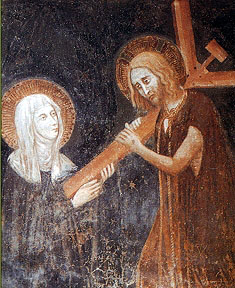
Clare (Italian Chiara) was born in 1268 in Montefalco in Umbria to an Italian Umbrian family. At the age of 6, she entered the hermit-community that her elder sister Bl. Joan of Montefalco was founding — the family-monastic-vocation pattern characteristic of the late-13th-century Umbrian Catholic tradition.
The Montefalco community regularized itself as an Augustinian nun-monastery under the Rule of St. Augustine — becoming the Monastery of the Holy Cross (Monastero di Santa Croce).
On Bl. Joan's death in 1291, Clare was elected abbess of the community at the age of 23 — serving as abbess for the 17 years until her death in 1308.
Clare became famous during her lifetime for her mystical-ecstatic experiences — receiving multiple visions of Christ's Passion, undertaking extreme ascetic disciplines, and reporting the reception of a miraculous inscription on her heart: the instruments of the Passion of Christ — the cross, the nails, the scourge, the spear, the sponge, the column, the crown of thorns — impressed as miraculous images on the tissue of her heart.
After her death on August 17, 1308, the nuns of the Montefalco monastery undertook the autopsy of Clare's body — in the expectation of verifying the reported heart-inscription. The autopsy — conducted by Sister Francesca on August 19, 1308 — verified the miraculous heart-inscription: the instruments of the Passion impressed as small fleshy sculptures within the tissue of Clare's heart, documented in detail by the canonical inquest.
Clare's incorrupt body — preserved to the present day — and the miraculous heart (preserved separately in a reliquary) are venerated at the Basilica of St. Clare of Montefalco. The canonical inquest of the miraculous heart-inscription — the medieval Catholic pre-modern equivalent of modern miraculous-body verification — became one of the principal Catholic mystical-corporeal narratives of the late medieval period.