
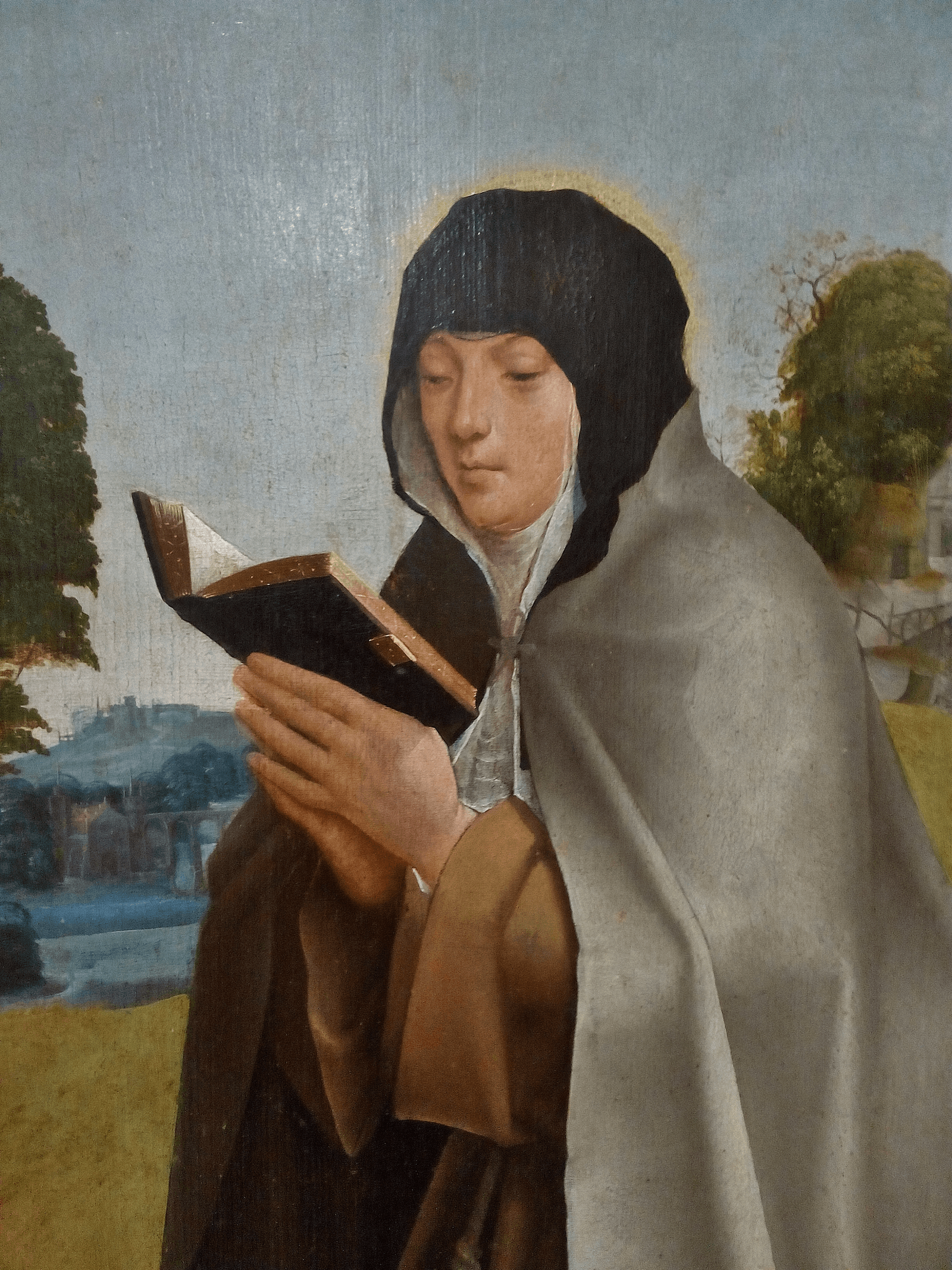
Nicolette Boylet was the only child, born after long prayers to St. Nicholas, of an elderly couple at Corbie in Picardy. She entered first the Beguines, then the Benedictines, then the Augustinians — finding none of them austere enough — and finally retired as a Franciscan tertiary in a small enclosed cell beside the Corbie abbey church, where she lived for four years as a recluse.
In 1406 she received in a series of visions a commission from St. Francis himself to restore the Poor Clares to the primitive observance of St. Clare — a discipline that had relaxed across the order during the long Western Schism. Pope Benedict XIII (the Avignon antipope who later supported her despite his own difficult position) authorized her work in 1406, gave her the habit of a Poor Clare, and named her Abbess General of all reformed convents. She spent the next forty years travelling across France, Burgundy, Savoy, and Flanders, reforming existing Poor Clare houses and founding new ones — seventeen new convents in her lifetime and far more after her death.
She was the spiritual director of the Burgundian dukes and their families, of Vincent Ferrer (who collaborated with her on healing the Schism), and of countless laypeople. She died at her last foundation, the Poor Clare convent of Ghent, on March 6, 1447. Canonized by Pius VII in 1807, she is the foundress of the Colettine branch of the Poor Clares, which remains today the strictest branch of the Order.