
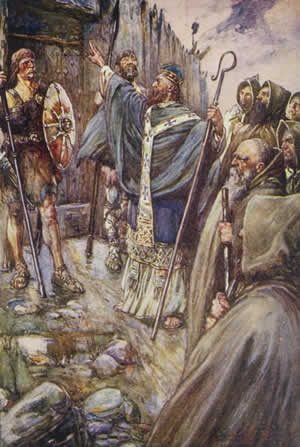
Columba (Irish 'Colum Cille,' 'dove of the church') was of the royal line of the Uí Néill of Donegal, a great-grandson of the High King Niall of the Nine Hostages. Trained by St. Finnian of Movilla and St. Finnian of Clonard, he founded a series of monasteries in Ireland — Derry, Durrow, Kells — before, around 563, taking twelve companions and crossing to the small island of Iona off the western coast of Scotland.
From Iona he evangelized the Pictish kingdoms of northern Scotland over the next thirty-four years, founding monasteries along the Highland glens and converting King Bridei of the Picts at his fortress on the river Ness (where Adomnán records Columba meeting and dismissing a 'water beast' in the Loch — the first written record of the Loch Ness creature, AD 565).
Iona became the spiritual capital of Celtic Christianity. From it the next century would send out the Irish missions to Northumbria (St. Aidan), to Lindisfarne, and across Anglo-Saxon England. The illuminated Book of Kells — among the most beautiful manuscripts ever produced — was written, by long tradition, at Iona before being moved for safekeeping to Kells in Ireland during the Viking raids.
His biographer Adomnán of Iona, ninth abbot in his succession, wrote the Life of Columba (Vita Columbae) around 700 — one of the great patristic and Celtic Christian texts.