
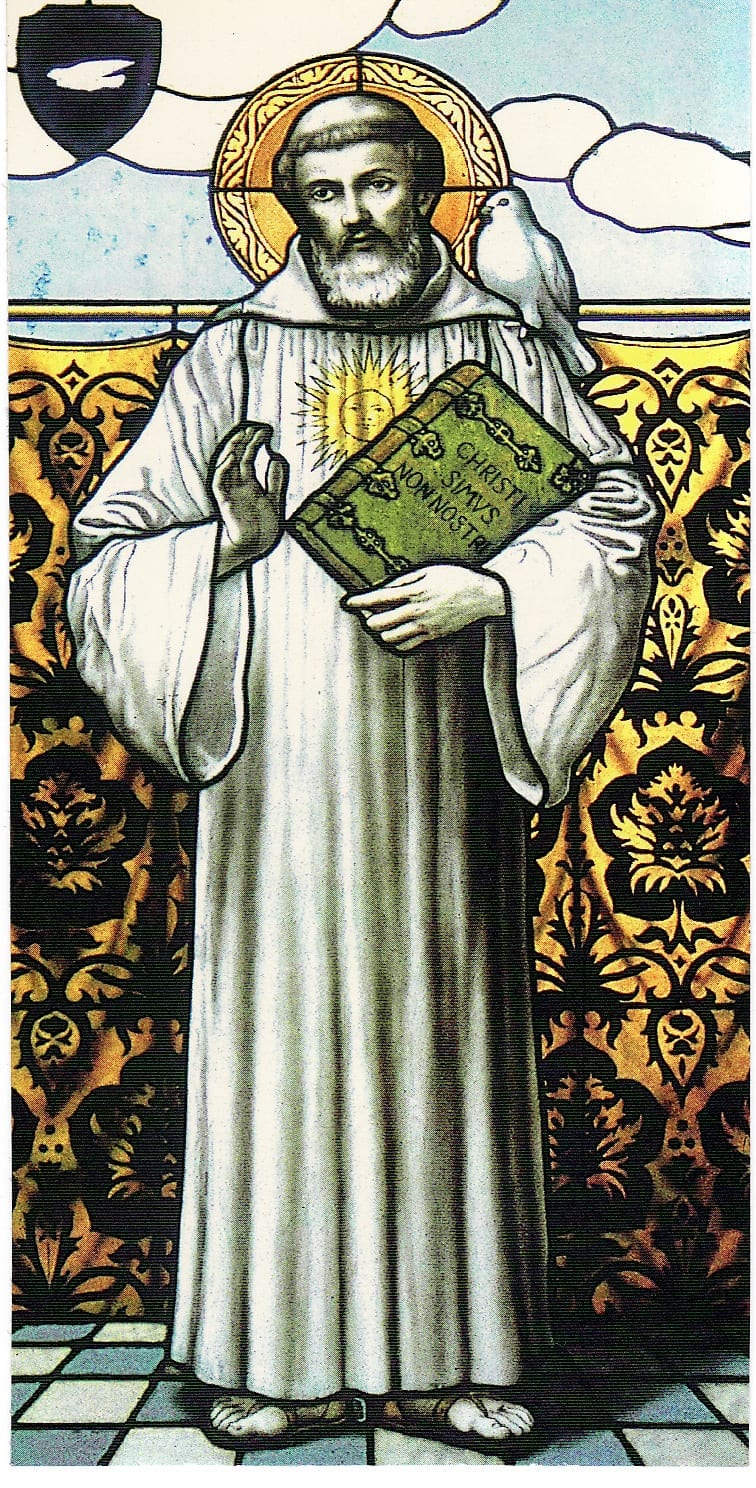
Columbanus was educated under St. Comgall at the great monastery of Bangor in northeast Ireland. Around 590 he left Ireland with twelve companions on a peregrinatio pro Christo — pilgrimage for Christ — and crossed to Gaul, where over the next twenty-five years he founded the great monasteries of Annegray, Luxeuil, and Fontaines in the Vosges.
His monastic rule was extraordinarily severe — built on the older Irish penitential tradition. He clashed repeatedly with the Frankish bishops over Easter dating and with the Merovingian kings (especially Queen Brunhild) over morality and the legitimacy of royal bastards. Expelled from the Frankish kingdom in 610, he traveled with his companions across the Alps to northern Italy.
There the Lombard king Agilulf gave him land at Bobbio in the Apennines, where in 614 he founded his last and greatest monastery. Bobbio became one of the most important centers of learning in early medieval Europe; its library housed copies of nearly every classical text to survive into the Middle Ages — including the unique surviving manuscript of Cicero's De Re Publica.
Through his disciples — St. Gall (founder of the great Swiss monastery at St-Gallen), St. Magnus, and others — and through his monastic rule (which preceded the Benedictine in much of central Europe), Columbanus transmitted Irish Christianity to the continent more deeply than any other figure. Pope Pius XI called him the 'wandering apostle of the Carolingians.'