
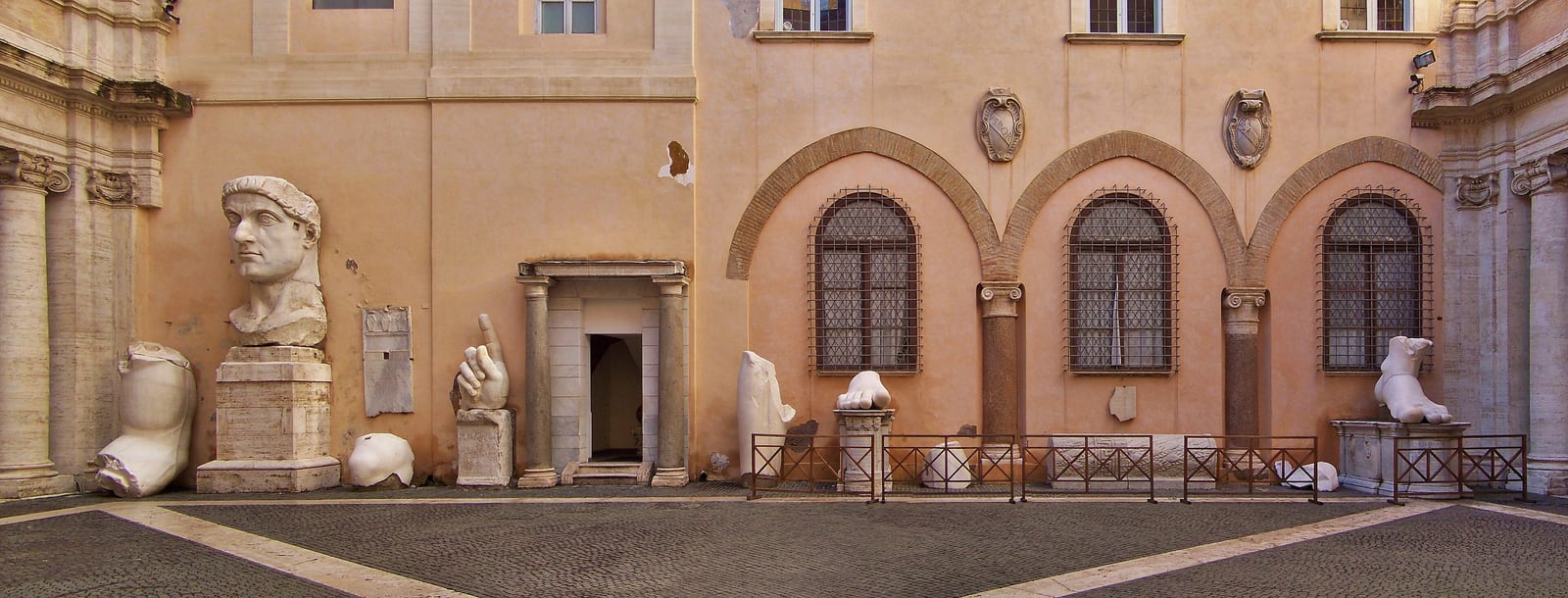
Constantine, son of Constantius Chlorus and Helena, was acclaimed emperor by his father's troops at York in 306. On the eve of the Battle of the Milvian Bridge against Maxentius in 312, he saw the vision of the Cross in the sky with the words 'In Hoc Signo Vinces' — 'In this sign you shall conquer.' He had the Chi-Rho painted on the shields of his troops and won the battle. The next year, with his co-emperor Licinius, he issued the Edict of Milan, legalizing Christianity throughout the Roman empire.
He summoned and presided over the First Council of Nicaea (325), at which the Arian heresy was condemned and the Nicene Creed formulated. He built the Basilica of the Holy Sepulchre at Jerusalem (entrusted to his mother's direction), Old St. Peter's at Rome, and the Hagia Sophia at Constantinople (the original 4th-century one, twice rebuilt). He moved the capital of the empire from Rome to Byzantium in 330, renaming it New Rome — Constantinople.
He postponed his own baptism until the deathbed (a common practice of the time, to receive forgiveness for all sin at once) and was baptized by Eusebius of Nicomedia on May 22, 337. The Eastern Churches venerate him together with his mother Helena as 'Equal-to-the-Apostles' (Isapóstoloi); the Roman Calendar does not include him but he is honored as a saint in Latin tradition.