
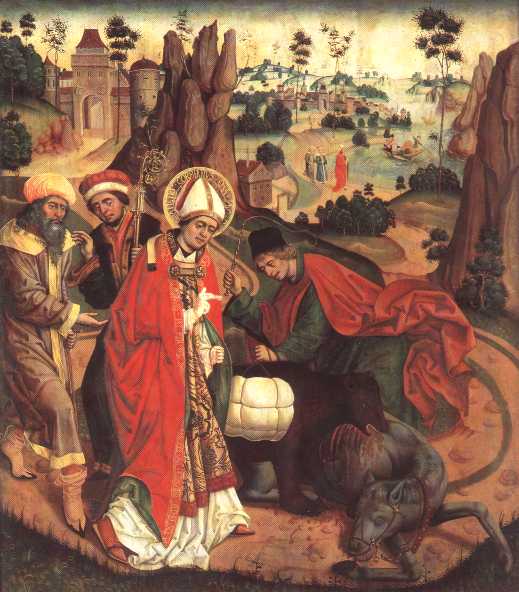
Corbinian was a Frankish-Gallic hermit who lived for fourteen years in the forest of Châtres before pilgrimaging to Rome around 715. Pope Gregory II made him a missionary bishop and sent him to evangelize the Bavarian frontier. He worked first along the Rhine, then settled around 724 at Freising in modern Bavaria, where he founded his cathedral church.
His most famous legend gives him the iconographic motif of the bear. On his second pilgrimage to Rome, a bear in the woods killed his packhorse. By legend, Corbinian commanded the bear to carry his pack the rest of the way to Rome — and the bear obeyed. The Corbinian bear is the central figure on the coat of arms of the Archdiocese of Munich and Freising, and was adopted by Pope Benedict XVI (who served as Archbishop of Munich and Freising before his election) as the personal element of his papal coat of arms.
He died at Freising on September 8, 730, and was buried first at his hermitage at Mais (near Bolzano), then translated to Freising in 769 — where his relics rest under the high altar of the cathedral.