
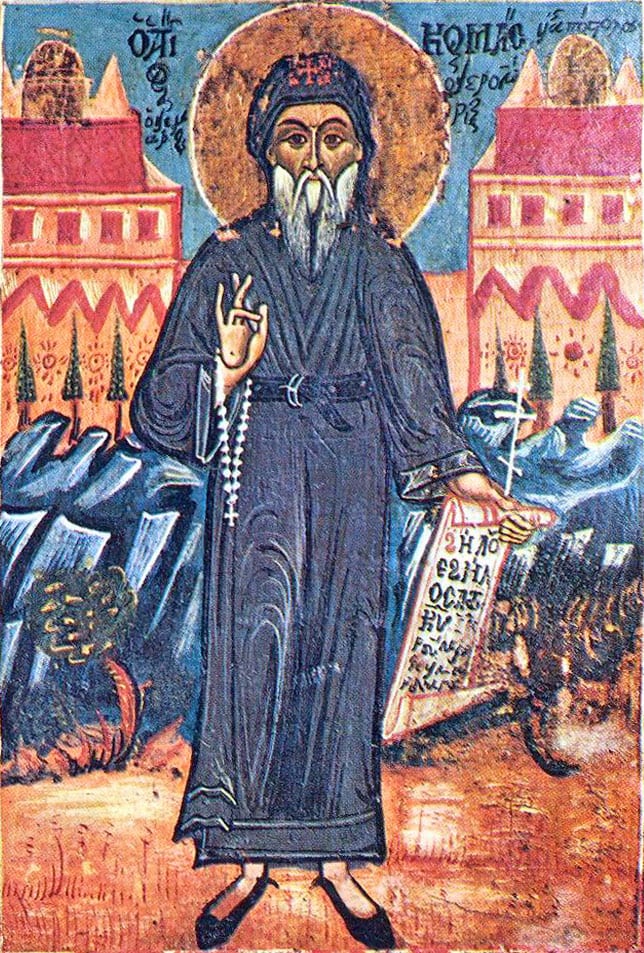
Konstantinos was born to a small peasant family in the Aetolian mountains in northwestern Greece, then under Ottoman rule. He studied at the Athonias Academy on Mount Athos — the major Orthodox Greek school of the period — and became a monk at the Athonite monastery of Philotheou in 1759 at forty-five, taking the religious name Kosmas.
From 1760 he undertook what proved to be a twenty-year wandering apostolic mission across the Greek-Orthodox lands of the Ottoman Empire — Macedonia, Thrace, Epirus, Thessaly, the Aegean islands, and the Albanian Orthodox communities of what is now southern Albania. His preaching was direct, vernacular, and shaped by the urgent crisis of Greek-Orthodox identity under the long Ottoman administration: he established over two hundred Greek-language elementary schools across the regions he visited (the foundation of the modern Greek school system, predating the Greek state by half a century), preached fierce Eucharistic and Sunday-Sabbath observance, and worked tirelessly against the social practice of converting young Greek Christian girls to Islamic marriage for economic reasons.
His preaching alarmed both Ottoman provincial authorities (he was tolerated by the central Sublime Porte after diplomatic intervention by his Patriarch, but was repeatedly threatened locally) and the Jewish merchant communities of the Macedonian and Thracian cities, whose Saturday market practices he condemned with sharp anti-Jewish rhetoric — the latter of which is a fact frankly recorded by his contemporary biographers and the subject of historical examination since. He was finally killed at Kolkondas in central Albania on August 24, 1779 — beheaded by Ottoman provincial authorities in conjunction with local Jewish merchants who had succeeded in obtaining his arrest. Canonized by the Ecumenical Patriarchate in 1961 — the only major Greek Orthodox saint of the 18th century.