
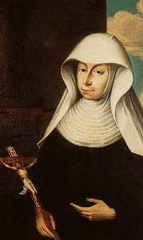
Anna Höss was born to a poor weaver's family in the Bavarian Allgäu town of Kaufbeuren and worked at her father's loom from childhood. From eight she had a deep intuitive Catholic piety unusual for her age and circumstances. She tried to enter the local Franciscan tertiary monastery of Kaufbeuren at twenty but was refused for lack of dowry. In 1703 — after the Protestant mayor of Kaufbeuren had gifted the convent a stake of value — Anna was admitted in fulfillment of his gift, taking the religious name Crescentia.
For the first nine years at the monastery she was treated harshly by the older sisters, who resented her dowryless admission — she was given the most menial tasks, denied food regularly, and humiliated systematically. She accepted the treatment in obedience without complaint. Around 1712 her hidden interior life began to manifest in physical phenomena: ecstasies, mystical Trinitarian visions, healings attributed to her intercession. The novice mistress and the abbess gradually came to recognize the supernatural. In 1741, at fifty-nine, she was elected superior of the monastery and served as such until her death.
Her teaching centered with unusual originality on the Holy Spirit — a relatively neglected devotional area in the contemporary Bavarian Catholic life. Her sustained devotion to the seven gifts and seven fruits of the Holy Spirit foreshadowed by over two centuries the Holy Spirit theology of the 20th-century Catholic Charismatic movement. She died at Kaufbeuren on April 5, 1744. Beatified 1900, canonized 2001 by John Paul II.