
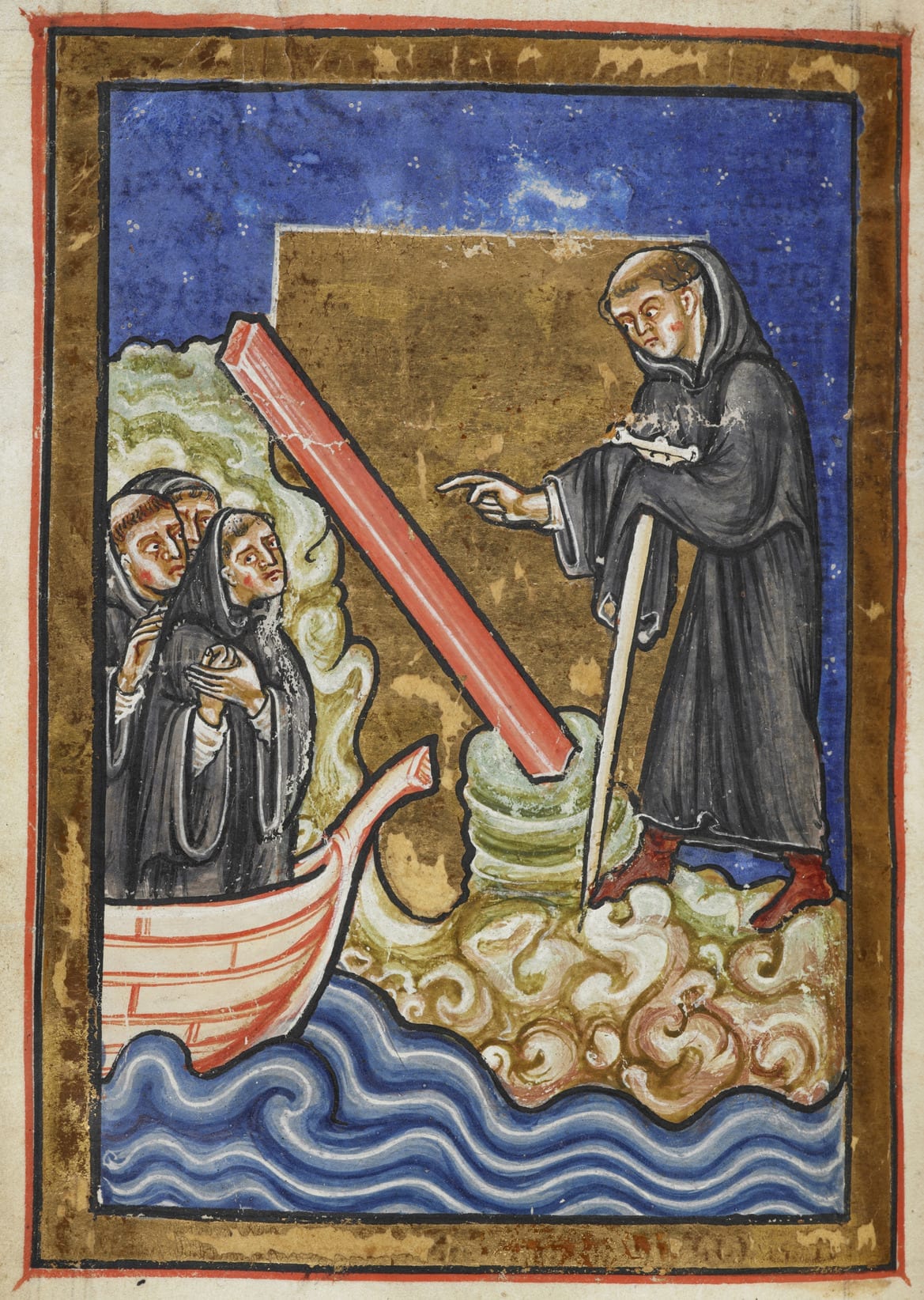
Cuthbert was a young shepherd in the Lammermuir hills when, on the night of August 31, 651, he saw the soul of St. Aidan of Lindisfarne carried to heaven in a great light. He went the next day to Melrose Abbey and was received as a monk by the abbot Eata and the prior Boisil.
He spent his next thirty years traveling Northumbria on foot, evangelizing remote upland villages, healing the sick — Bede calls him the great preacher of the northern hills. He was prior at Melrose and then at Lindisfarne; he founded a hermitage on the Inner Farne Island where, after two years of episcopal service to which he was reluctantly elected, he returned to die on March 20, 687.
Buried at Lindisfarne, his body was found incorrupt eleven years later (698) at the monks' translation of his relics into a new shrine. The body remained incorrupt through the great trials of the medieval period. When the monks fled Lindisfarne under Viking attack in 875 they carried his body inland; it traveled for over a century with the wandering community of St. Cuthbert until they settled at Durham in 995, where they built the great cathedral that today is one of the masterpieces of Norman architecture in Europe.
His body was buried again at Durham in 1104; the tomb was opened in 1827 and the body was still partially incorrupt. He is the patron of northern England and the principal saint of Durham; his beautiful Lindisfarne Gospels (c. 700), copied at his old monastery in honor of his shrine, are one of the most precious manuscripts of the British Library.