
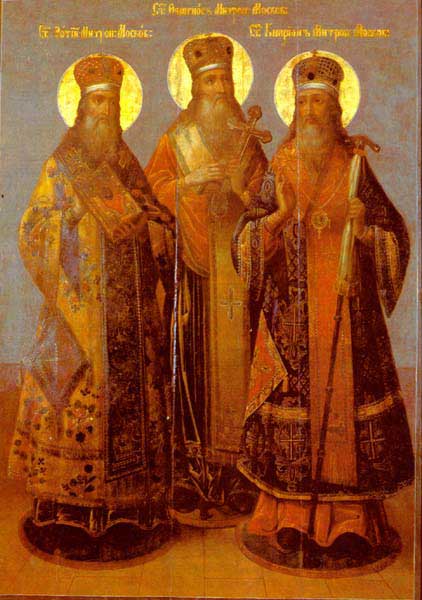
Cyprian (Bulgarian Kiprian, Russian Киприан) was born around 1336 at Tarnovo in the Second Bulgarian Empire to a Bulgarian noble family. He received his monastic formation at Mount Athos and became a spiritual disciple of the Athonite hesychast tradition (the spiritual tradition of Sts. Gregory Palamas and Gregory of Sinai).
Around 1373, the Ecumenical Patriarch Philotheos Kokkinos of Constantinople appointed Cyprian as papal-patriarchal legate to the Slavic Catholic-Orthodox lands. In 1375, Cyprian was consecrated Metropolitan of Kiev, Rus', and Lithuania — the Constantinopolitan ecclesiastical response to the contested succession of the Kievan Metropolitanate.
The period of the Metropolitan-Cyprian ministry coincided with the Great Western Schism (1378–1417) in the Latin Catholic Church and with the contested Kievan-Muscovite political succession — producing the Kievan-Metropolitan crisis of the 1375–1390 period. Cyprian spent multiple years in Lithuanian Kiev (1375–1381) and Moscow (1381–1382, 1390–1406), periodically displaced by political-ecclesiastical rivals.
From 1390 to his death in 1406, Cyprian served as sole Metropolitan of Kiev and All Rus' — uniting the entire Kievan-Rus' ecclesiastical province under his single metropolitan authority.
Cyprian's institutional legacy is the systematic liturgical-reform of the Slavic Catholic-Orthodox tradition — introducing the Athonite hesychast liturgical texts and the Slavic-Orthodox liturgical uniformity across the Kievan-Muscovite ecclesiastical province.
He died at his country residence at Golenishchevo near Moscow on September 16, 1406. His relics were translated to the Cathedral of the Dormition at the Moscow Kremlin in 1472.