
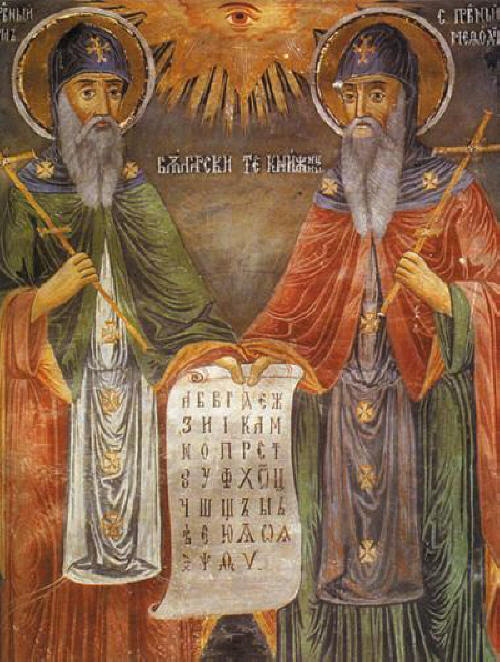
Constantine was the youngest of seven sons of a senior Byzantine military officer of Thessalonica — a city with a substantial Slavic-speaking suburban population, where Constantine grew up bilingual in Greek and Slavonic. Educated at the imperial school in Constantinople under the future patriarch Photius, he became professor of philosophy at the Magnaura School and was already known across the empire as 'the Philosopher.'
In 862 the Moravian Prince Rastislav asked the Byzantine emperor for missionaries who could preach in Slavonic. Constantine and his elder brother Methodius were chosen. To create a literary Slavonic, Constantine devised the Glagolitic alphabet — the earliest Slavic alphabet, the parent of all subsequent Cyrillic scripts — and translated the Gospels, the Psalter, and the divine liturgy into a literary Slavonic dialect (Old Church Slavonic) that became the third great liturgical language of medieval Christianity after Latin and Greek.
Summoned to Rome by Pope Hadrian II to defend the Slavonic liturgy against Frankish opposition, Constantine arrived in 868 carrying the relics of Pope Clement I that he had discovered earlier in the Crimea. Hadrian formally approved the Slavonic liturgy and consecrated the Bulgarian and Moravian translations. Constantine entered the monastery of San Clemente at Rome, taking the monastic name Cyril, and died there fifty days later on February 14, 869. He is buried in the Basilica of San Clemente in Rome — the church that holds the relics of the Roman pope whose body he had recovered. Pope John Paul II in 1980 named him Co-Patron of Europe with Methodius and St. Benedict.