
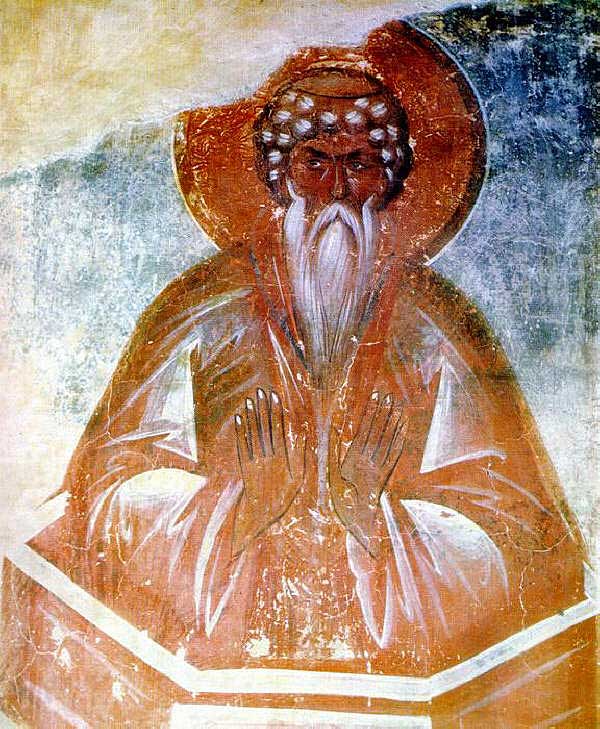
Daniel (Greek Daniēl) was — per the foundational contemporary biography composed by an anonymous Constantinopolitan monk who knew him personally (one of the most historically reliable of all 5th-century saint's lives) — born to a Syrian Christian family of Maratha near Samosata around 409 AD. At the age of twelve he entered the nearby monastery of Beth Abbe and remained there for some twenty-five years.
In 451 AD — at the age of forty-two and after the foundational Council of Chalcedon — Daniel undertook a long pilgrimage that took him eventually to the great pillar of St. Simeon Stylites the Elder at Telanissos (see Simeon Stylites's entry already in the catalogue). Daniel was at Simeon's pillar when Simeon died on September 2, 459, and was personally given by the dying Simeon his foundational stylite habit and the foundational stylite commission to continue the pillar-saint tradition.
Daniel travelled to Constantinople and around 460 AD established himself on a small pillar at Anaplus on the European shore of the Bosphorus a few kilometres north of Constantinople. He remained on the pillar (and on two subsequent larger pillars built around the same site) for the next thirty-three years until his death on December 11, 493 — the most extended documented continuous-pillar-residence in the entire stylite tradition.
His historical importance comes from his unique role as the only foundational stylite saint to establish his pillar at the very centre of imperial-political power. Anaplus was within easy boat-distance from the Constantinopolitan imperial palace; throughout the long late 5th century — through the reigns of the Emperors Leo I (457–474), Zeno (474–491), and Anastasius I (491–518) — Daniel from his pillar at Anaplus became the principal personal spiritual director of the Eastern Roman imperial court and the Constantinopolitan ecclesiastical leadership. The Emperor Leo I made monthly pilgrimages to the pillar; the Patriarchs of Constantinople consulted him regularly. He was instrumental in the eventual deposition of the Monophysite usurper Basiliscus (475–476) and the restoration of Zeno.
He is the foundational example of the Eastern-Christian model of the pillar-saint as imperial-political spiritual director. His example was substantially imitated through the 6th and 7th centuries by the substantial Constantinopolitan-area stylite tradition (Daniel was succeeded directly on his Anaplus pillar by his disciple Anatolius, and indirectly by a continuous line of Constantinopolitan stylites until the early 7th century).