
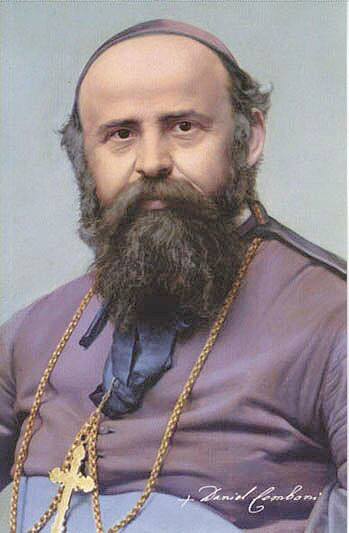
Daniele Comboni was born to a small Lombard family at Limone sul Garda on the western shore of Lake Garda. He was educated at the African Missions Institute (Istituto Mazza) of Verona — the school founded in the 1840s by Father Nicola Mazza specifically for the training of Italian Catholic missionaries to Africa. He was ordained priest at Verona in 1854 at twenty-three.
His first African mission (1857–59) was to the Sudanese Catholic mission of the Vicariate Apostolic of Central Africa — at that time the most lethal Catholic mission in the world: of the missionaries sent to Sudan between 1846 and 1859, over 80% died of malaria, sleeping sickness, dysentery, or other tropical diseases within their first three years. Comboni himself contracted severe malaria and was evacuated. His response — formulated as he recovered at Verona in the early 1860s — became the foundation of modern Catholic African missionary strategy: the famous principle 'Salvare l'Africa con l'Africa' ('Save Africa with Africa') — that the conversion of Africa could only be accomplished by Africans, and that European missionary work should focus on training native African Catholic clergy, religious, and lay leaders.
In 1867 he founded the Verona Fathers (Comboni Missionaries, MCCJ) specifically for the training of European missionary clergy committed to the African mission, and in 1872 the Comboni Missionary Sisters (Comboni Missionary Sisters Pie Madri della Nigrizia, MCS). He was appointed Pro-Vicar Apostolic of Central Africa in 1872 and consecrated Bishop of Claudiopolis (titular see) and Vicar Apostolic of Central Africa in 1877 — making him the first Catholic bishop officially resident in modern Sudan.
He governed the Sudanese Catholic mission from Khartoum through the catastrophic Mahdist rebellion years of the late 1870s (the Mahdi would capture Khartoum and kill General Gordon four years after Comboni's death). He died of cholera at Khartoum on October 10, 1881 at fifty. His Comboni congregations remain the principal Italian Catholic missionary congregations to sub-Saharan Africa — with substantial communities in Sudan, South Sudan, Uganda, Kenya, Ethiopia, Mozambique, Brazil, and several other countries. Canonized 2003.