
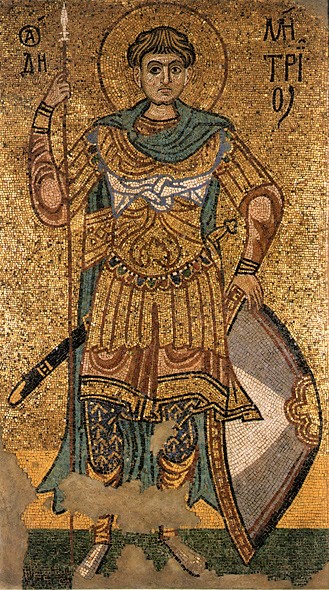
Demetrius (Greek Dēmētrios) was — per the universal Byzantine tradition — a young Roman patrician of Thessalonica, the son of a senior Roman provincial military commander. He had been secretly raised Christian by his father in the years of the brief peace before the Great Persecution. At his father's death, the young Demetrius was appointed by the Emperor Maximian as proconsul of Thessalonica and commander of the city's garrison.
When Maximian arrived at Thessalonica in 306 with the order to enforce the Diocletianic edicts and to suppress the substantial Thessalonian Christian community, Demetrius — instead of carrying out the order — used his position to publicly catechize the Thessalonian population in the Christian faith. He was arrested by Maximian's personal order and imprisoned in a small cell under the Roman baths of the city.
From his cell Demetrius continued his ministry — most famously to his young disciple Nestor, who came to him asking for blessing to enter the gladiatorial arena to fight the giant Vandal champion Lyaeus, the favourite of Maximian. Demetrius blessed him with the sign of the cross; Nestor entered the arena and killed Lyaeus with a single thrust, then publicly declared the victory as Christ's. Maximian, enraged, ordered both Nestor and Demetrius killed: Nestor was beheaded, and Demetrius was pierced with multiple spears in his cell — the iconographic centrepiece of his cult.
His body was buried at the cell-site, and the great Church of Saint Demetrios at Thessalonica was built over it in the early 5th century (rebuilt repeatedly across the centuries — the present basilica largely 7th-century with later restorations is one of the great surviving early-Byzantine churches). The cell-cult-tomb (the Crypt of St. Demetrios) is preserved beneath the basilica and is one of the principal Eastern Orthodox pilgrimage sites of the world. His cult is universal in the Byzantine tradition; he is venerated as a 'Great Martyr' (megalomartyr) — one of the small group of supremely important martyrs of the Eastern Catholic and Orthodox traditions (with George, Theodore, Mercurius, and a few others).