
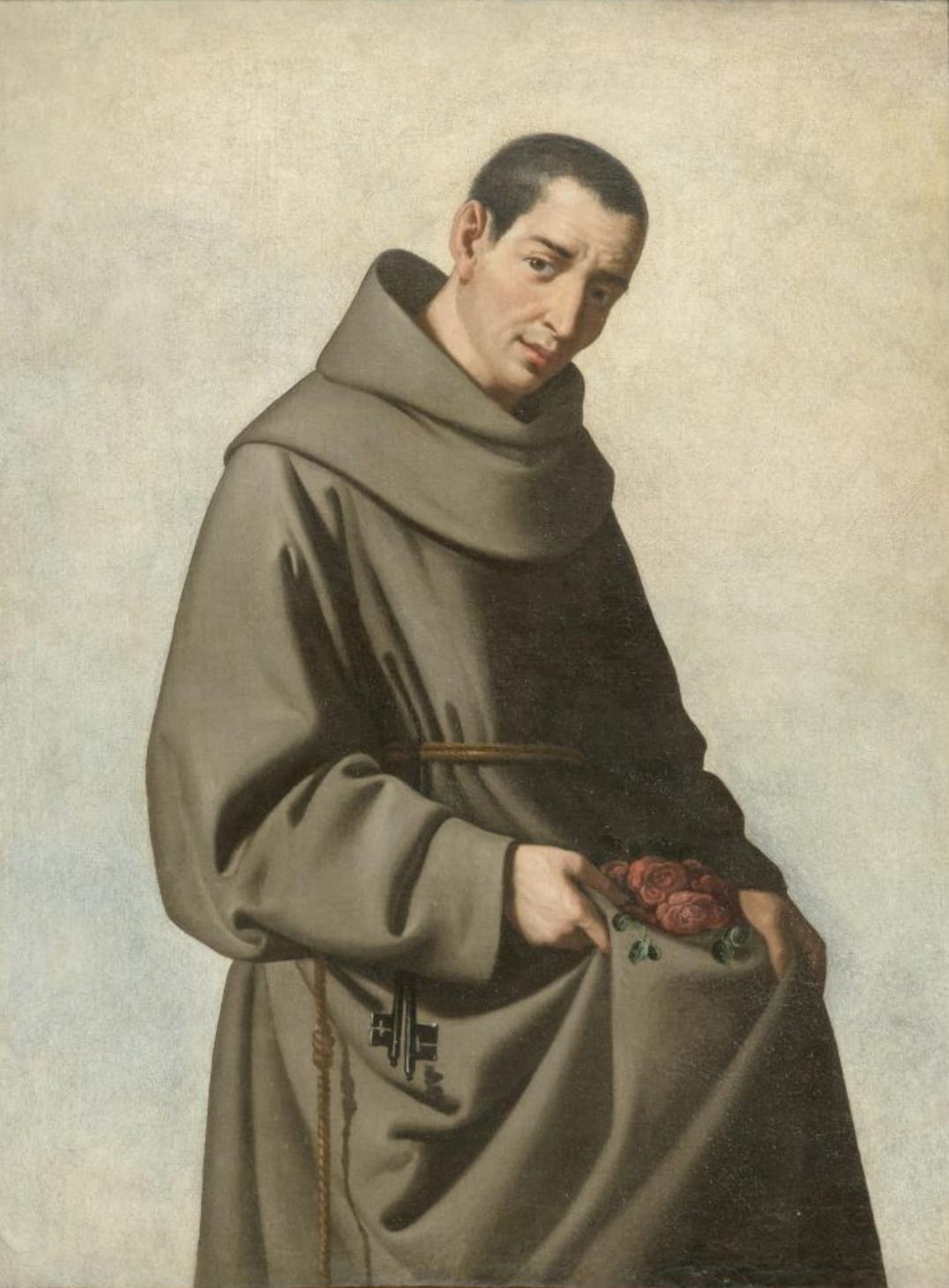
Diego of San Nicolás was a poor Andalusian peasant who lived for years as a hermit before entering the Observant Franciscans as a lay brother around 1430. He never sought ordination and was illiterate, but was widely consulted as a spiritual guide. In 1441 he was sent as part of the new Franciscan mission to the recently-conquered Canary Islands — to Fuerteventura — where he served as guardian of the small friary at Betancuria and is credited with the rapid conversion of the indigenous Guanche population on the island.
He returned to Spain around 1450 and worked at a series of small friaries, finally settling at the convent of Santa María de Jesús at Alcalá de Henares. There he became the cook, gardener, and porter, a man of intense Eucharistic and Marian devotion, known for ecstasies during prayer (witnessed by his fellow friars), and for his work with the city's poor.
He died at Alcalá on November 12, 1463. The cult exploded immediately: a hundred and twenty-five years later, in 1562, the future King Philip II of Spain promised to support the canonization process after his son Don Carlos — gravely injured in a fall down a staircase at Alcalá — was cured at the touch of Diego's incorrupt body. Sixtus V canonized him in 1588 — the first canonization of any kind under the new Tridentine norms, and the first Franciscan in over a century. The mission and city of San Diego in California are named after him.