
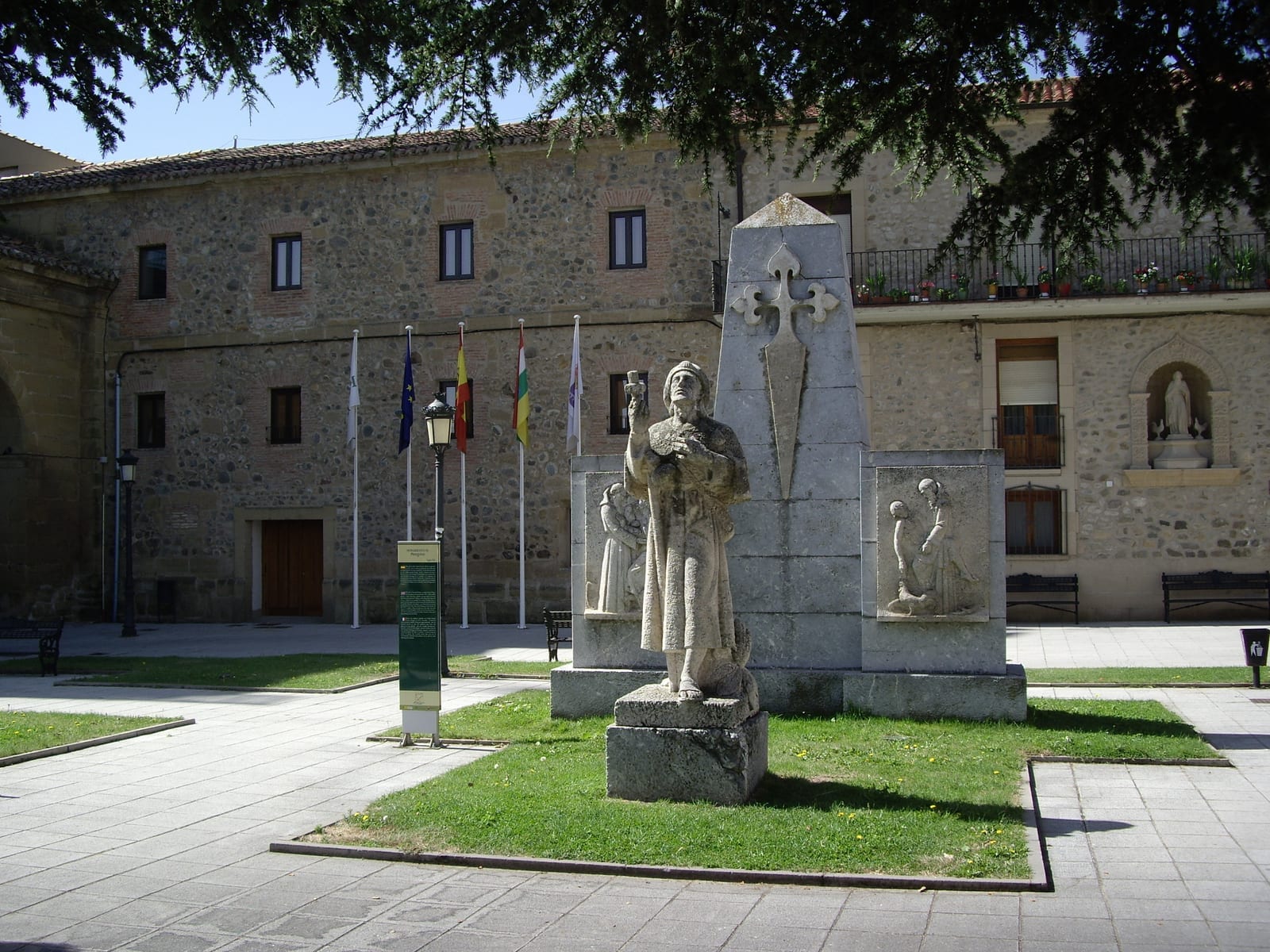
Dominic was born around 1019 in Viloria de Rioja in La Rioja, Castile, to a Spanish Catholic peasant family. Twice rejected for the monastic life at the Abbeys of San Millán de la Cogolla and Valvanera (his lack of classical Latin education was the cited reason), he undertook the hermit life in the dense oak forest of La Bureba — alongside the developing Way of St. James pilgrim route between the Pyrenees and the tomb of St. James the Greater at Santiago de Compostela.
Around 1044, becoming the disciple of St. Gregory of Ostia (the papal-legate Cardinal of Ostia who was then working on the reorganization of the Spanish Catholic Church under the Cluniac-papal reform), Dominic undertook an apostolate of civil engineering and pilgrim-hospitality for the Way of St. James — the pivotal Catholic decision that would produce his permanent patronage.
Over the six decades, Dominic undertook massive engineering works on the Camino: clearing the dense oak forest with his personal axe, constructing a stone causeway (the 'calzada' that gave him his name — 'Dominic of the Causeway') across the marshy floodplain of the Oja river, building a stone bridge over the Oja, constructing a pilgrim-hospital and church for the pilgrim community that grew at the settlement.
The settlement at the pilgrim-hospital became the town of Santo Domingo de la Calzada (the town bearing the saint's name and the saint's patronage), one of the principal pilgrim-stages of the Way of St. James to the present day.
Dominic died at his pilgrim-hospital on May 12, 1109. The pilgrim-hospital church became the Cathedral of Santo Domingo de la Calzada in 1232; the town survives in active Catholic liturgical use as the principal pilgrim-stage of the Camino, a UNESCO World Heritage Site as part of the official Routes of Santiago de Compostela in Spain.
The Cathedral is famous for the unique tradition of housing live chickens in a coop within the cathedral itself — commemorating the famous late-medieval miracle in which a young pilgrim falsely accused of theft and hanged on the town gallows was found still alive several weeks later (preserved by the saint's intercession); when the mayor at his dinner dismissed the reported miracle by declaring the pilgrim was as dead as the roasted chicken on his plate, the roasted chicken rose from the plate and crowed (the famous local saying: 'Santo Domingo de la Calzada, donde cantó la gallina después de asada' — 'Santo Domingo de la Calzada, where the chicken sang after being roasted'). The live-chicken coop within the cathedral commemorates the miracle to the present day, one of the most distinctive Catholic devotional traditions in the world.