
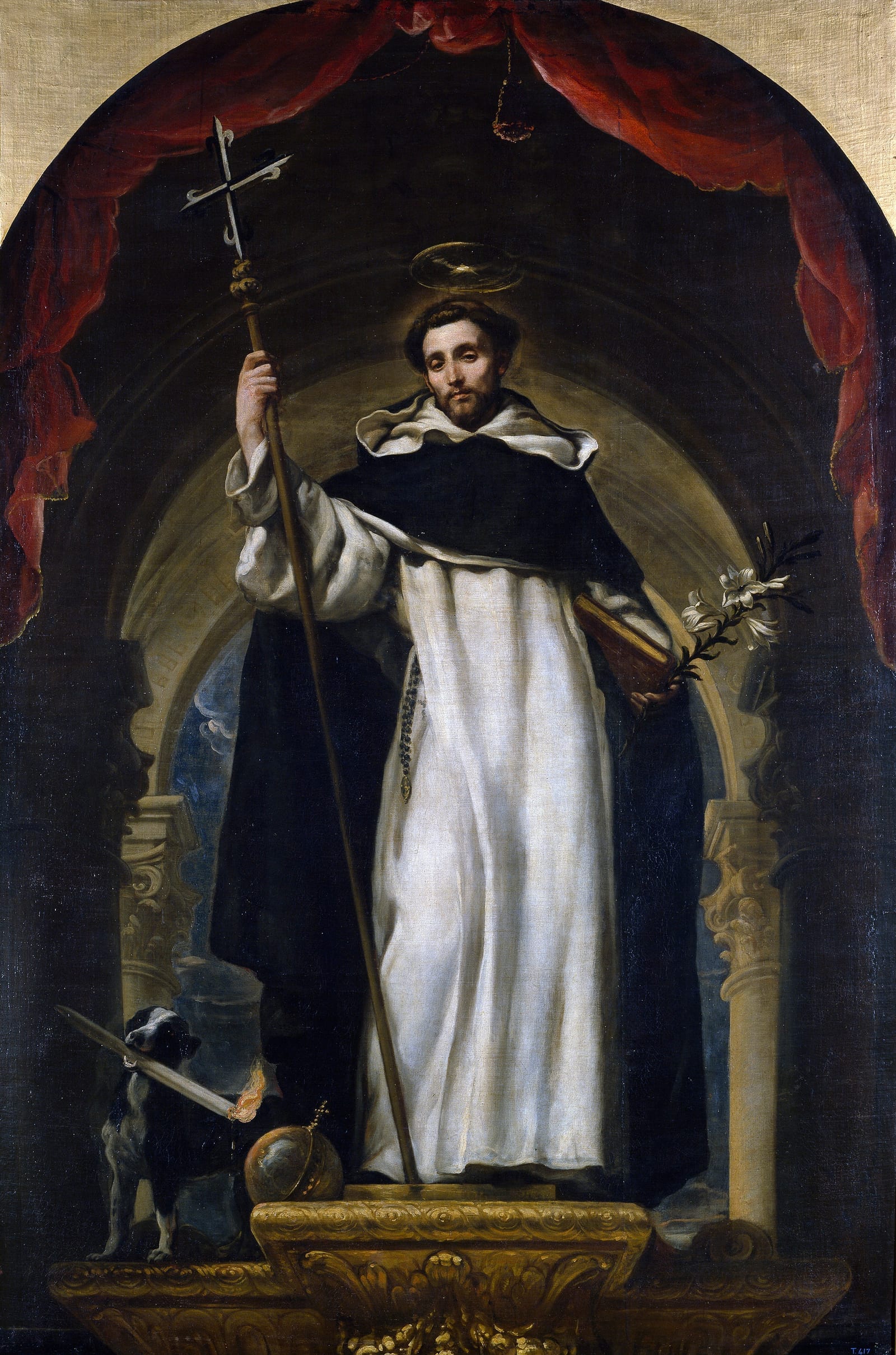
Dominic was born at Caleruega to the de Guzmán family of Old Castile, educated at Palencia, and became a canon of Osma cathedral under Bishop Martin de Bazán, then sub-prior under his successor Bishop Diego. In 1203 he travelled with Diego across southern France and discovered both the Cathar crisis and the inadequacy of episcopal-style preaching against it. From 1206 to 1216 he preached on foot in apostolic poverty across Languedoc — first with Diego, then alone after Diego's death — engaging in formal public debates with Cathar perfecti, founding a women's house of converts at Prouille (the seed of Dominican nuns), and establishing the model of an itinerant preaching brotherhood that would eat, beg, and travel like the Cathars themselves.
In 1215 he obtained Bishop Foulques of Toulouse's authorization for the first community of preachers; in 1216 Pope Honorius III confirmed the Order of Preachers (Ordo Praedicatorum, OP). Dominic refused all episcopal offers and dispatched the small original community — sixteen brothers — to Paris, Bologna, Madrid, and Rome to study and preach. By his death five years later there were more than 500 Dominicans in 60 priories across Europe.
He died at Bologna in August 1221, exhausted by ceaseless travel and preaching. His body lies in the great marble Arca di San Domenico in the basilica of San Domenico, Bologna — a tomb to which Nicola Pisano, Arnolfo di Cambio, Niccolò dell'Arca, and the young Michelangelo all contributed across three centuries. The Rosary tradition (later codified by the Dominican Alan de la Roche in the 15th century) attaches itself to him; whether or not he composed its present form, the Dominican Order has been the principal historical guardian of Marian devotion through the Rosary.