
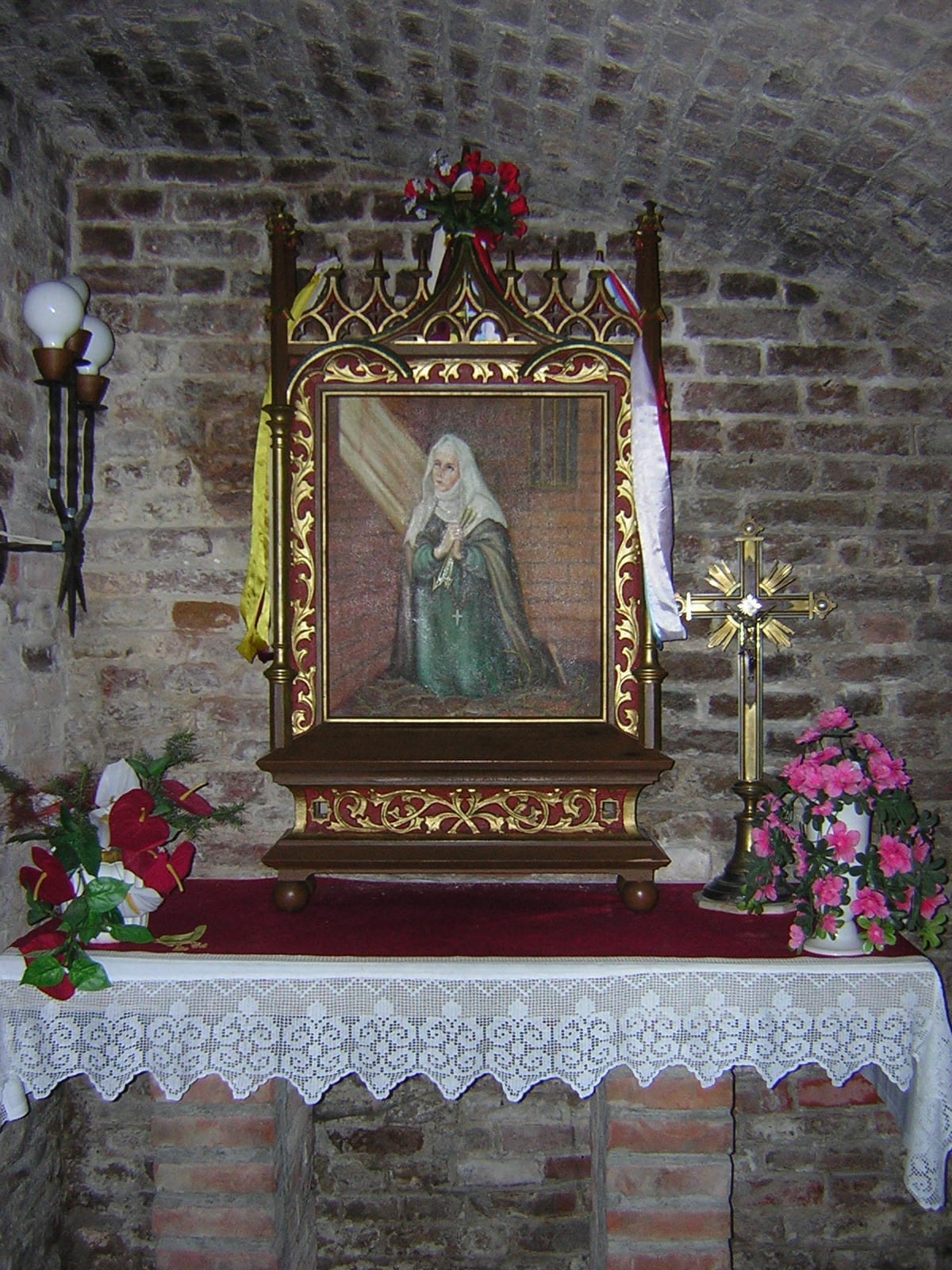
Dorothea Swartze was born at Montau in Pomerelian Prussia, in the territory then controlled by the Teutonic Order. She married a Gdańsk swordsmith named Adalbert at sixteen and bore him nine children — eight of whom died in childhood, mostly during plague waves. The eighth was struck by lightning at age six. The marriage was unhappy: Adalbert was harsh and intermittently brutal. Dorothea endured it for thirty-three years with extraordinary patience that her later confessor Johannes Marienwerder recorded in great detail.
From around 1378 she began the series of mystical experiences that her hagiographers would catalogue — visions of Christ, of his Passion, of the souls of her dead children among the angels — together with extreme physical phenomena (sweats of blood, ecstatic levitations, stigmatic marks at her side). Pilgrimage journeys to Aachen, Einsiedeln, and finally Rome (1390) brought her some peace; Adalbert died in 1390 during her Rome pilgrimage.
Returning a widow, she sought enclosure as an anchoress at Marienwerder (Kwidzyn) Cathedral. The Teutonic Order's bishop Johannes Mönch and her future biographer Johannes Marienwerder enclosed her there on May 2, 1393. She lived in the small cell beside the cathedral choir, walled in with only a small grate for confession and Communion, for thirteen months until her death on June 25, 1394. Beatified by Paul VI in 1976, she is the patroness of Prussia.