
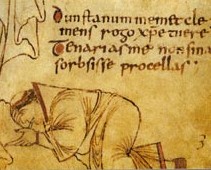
Dunstan was educated at Glastonbury Abbey, where his uncle was bishop. Skilled as a metalworker, illuminator, and harper, he came to King Æthelstan's court as a young scholar-craftsman. Calumniated and driven from court, he returned to Glastonbury and entered the monastery; King Edmund made him abbot in 940.
Under Edmund and his successors he transformed Glastonbury into the principal monastic foundation of England, the model on which Anglo-Saxon monasticism was rebuilt after a century of Viking destruction. He served as Bishop of Worcester, then of London, then finally Archbishop of Canterbury from 960 until his death.
Together with Æthelwold of Winchester and Oswald of Worcester — his close collaborators — he led the Tenth-Century Monastic Reform, the English chapter of the broader European reform movement that produced Cluny. The Regularis Concordia of c. 970, which he largely drafted, was the foundational document of Anglo-Saxon monasticism for the next half-century.
He also crowned King Edgar at Bath in 973 with the rite that has been the foundation of every English coronation ever since — including those of Charles I, Charles II, and Charles III. He died at Canterbury in 988. The famous legend that he caught the devil by the nose with his blacksmith's tongs gave him his patronage of goldsmiths.