
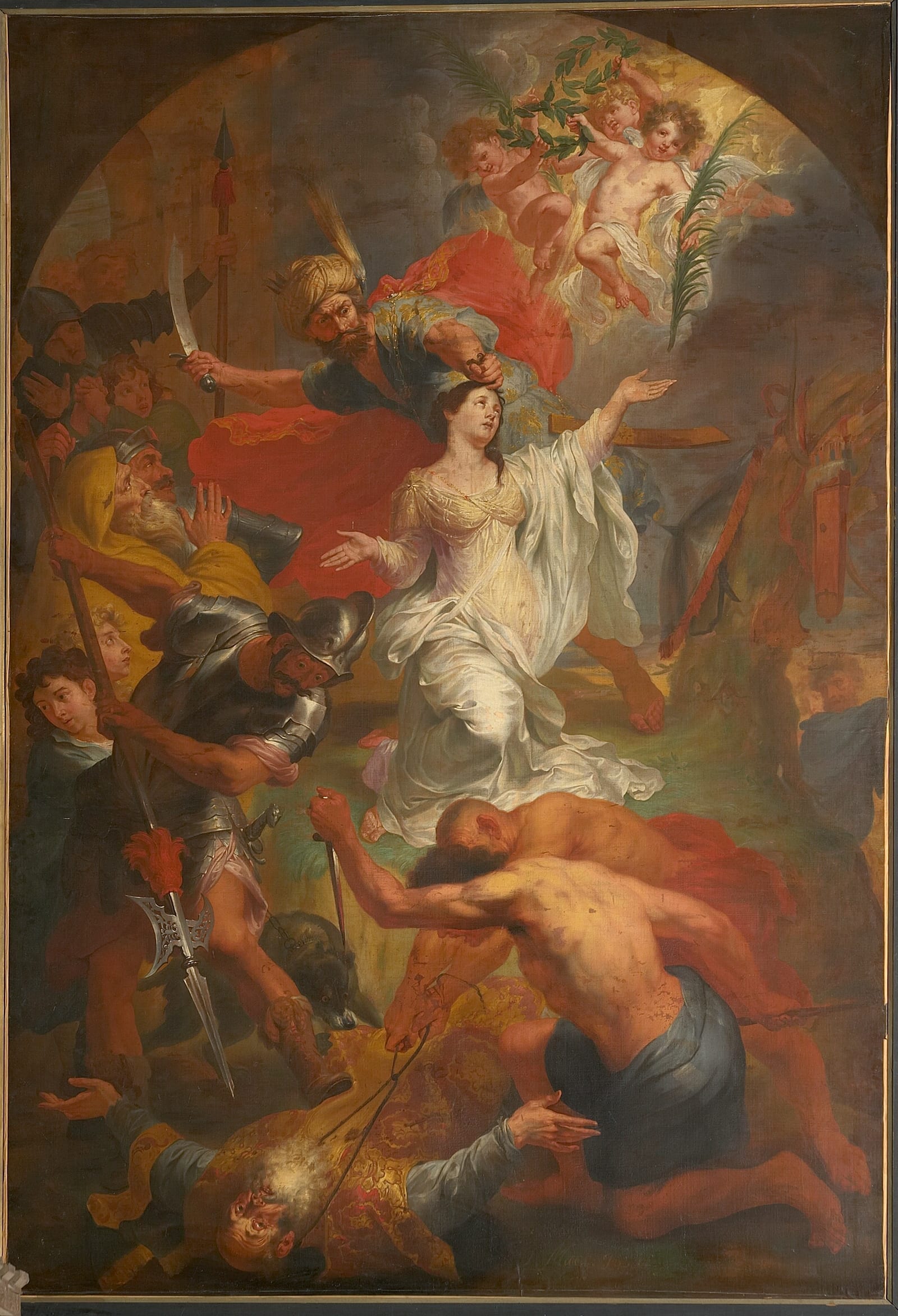
Dymphna, the tradition tells, was the daughter of a pagan Irish chieftain named Damon and a Christian mother of remarkable beauty. Baptized secretly and vowed to Christ at fourteen, she fled Ireland when her mother died and her father, deranged by grief, resolved to marry the daughter who most resembled his dead wife. With her confessor, the old priest St. Gerebernus, she crossed to the continent and settled at Geel in Brabant, where the fugitives lived quietly and served the poor and sick of the region.
Damon's agents traced them — the legend says by the trail of coins like those the fugitives spent. The king followed, and at Geel made his demand a last time. When Dymphna refused, he had Gerebernus killed and, when she still refused, struck off his daughter's head with his own sword. She was about fifteen. The townspeople buried the two martyrs; when the remains were translated in the thirteenth century, the account records, they were found in two white tombs of a stone not native to the region — taken as a sign of angelic burial.
The oldest written life dates only from the 1240s, composed from long oral tradition, and its authors admitted as much — the history is legend in form. What is historical fact, and extraordinary, is what her cult built: from the Middle Ages the mentally afflicted were brought on pilgrimage to her tomb at Geel, and when the church's sickrooms overflowed, the townspeople began taking the pilgrims into their own homes. From this grew the Geel family-care system — psychiatric patients boarding as members of ordinary households, some for decades — which has run continuously for some seven centuries and is still studied as a model of community psychiatric care.
Her relics rest in a silver reliquary in the Gothic church of St. Dymphna at Geel; St. Gerebernus's lie mostly at Xanten. Devotion to her as patroness of nervous and emotional affliction has spread worldwide, with a major national shrine at Massillon, Ohio.