
MIRACULOUS MIRACLES™

Saint — Edith of Wilton

St. Edith of Wilton
c. 961 AD, Kemsing, Kent (royal palace of King Edgar) — September 16, 984 AD, Wilton Abbey, Wiltshire
Anglo-Saxon royal abbess; daughter of King Edgar the Peaceful
Wilton Abbey, Wiltshire, England — her lifelong monastic home; the abbey was destroyed in the 1539 Reformation dissolution, but the medieval village church of Wilton survives with the dedication to St. Mary and St. Edith, United Kingdom
Feast
September 16
Canonized
Pre-congregation; cult established immediately at Wilton
Life

Edith was born around 961 to King Edgar the Peaceful and Wulfthryth — a young noblewoman whom the king had taken from the Wilton women's-abbey nunnery (where she was a novice) and compelled into a morganatic marriage. After Edith's birth, the queen-mother Wulfthryth returned to Wilton with the infant Edith and the two lived as royal-monastic mother-and-daughter at the abbey for the rest of their lives.

Edith was educated at Wilton from infancy under her mother (who became abbess of Wilton, and who is also venerated as a saint). She refused multiple royal proposals (marriages to continental nobles, the throne of Wilton Abbey itself, the kingship of Wessex in succession to her martyred half-brother King Edward in 978) — choosing to remain a simple nun at Wilton in the habit of a royal embroideress.

She was renowned for her embroidery — producing the ceremonial vestments and altar-cloths for the Wessex Catholic episcopate — and for her gentle care of the poor at the abbey-gate of Wilton.

She died on September 16, 984, at the age of 23. Her reputation for sanctity was so immediate that Archbishop Dunstan of Canterbury (her maternal uncle by ecclesiastical kinship) translated her relics in 997 to a new shrine at Wilton — the principal pilgrim destination of Wiltshire throughout the medieval centuries.

Miracles & Phenomena
  • The vision of Dunstan and Æthelwold

    Tradition recorded in the Vita Sanctae Edithae records that on the night of Edith's death (September 16, 984), Sts. Dunstan and Æthelwold separately had visions of the young abbess being received into heaven by the angels — the visions communicated to the Wessex episcopate the sanctity of the young Wilton nun.

  • The royal-monastic refusal pattern

    Edith's lifelong refusal of royal-political offers (marriage to continental princes, abbey-leadership, succession to the Wessex throne in 978 after her brother Edward's martyrdom) and her consistent choice of simple monastic embroidery and care-for-the-poor — established the pattern of the Anglo-Saxon royal-monastic women's tradition that would extend through the medieval centuries to Sts. Edith of Polesworth, Edburga of Winchester, and the royal-Wessex women's monastic tradition.

Relics
  • Body
    Shrine of St. Edith
    Wilton Abbey, Wiltshire — the medieval shrine destroyed in the Reformation dissolution of 1539; the village church of Wilton (St. Mary and St. Edith) preserves the dedication; some relics translated to Wilton House and to continental Catholic shrines

    Her medieval shrine at Wilton Abbey survived until the 1539 dissolution; the ruined abbey was destroyed and its stones used in the Tudor mansion of Wilton House. The village church of Wilton preserves the dedication, and the Catholic and Anglican parishes of Wiltshire maintain the St. Edith pilgrim tradition.

Iconography
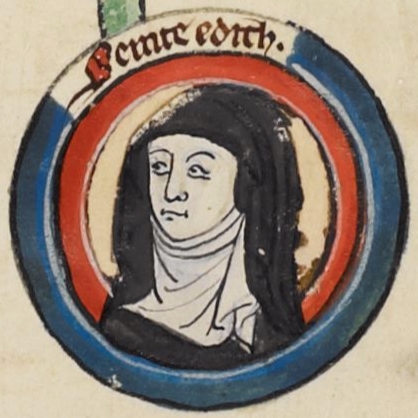
  • Edith embroidering at Wilton

    The late-10th-century Anglo-Saxon young royal nun in Benedictine habit at the embroidery-frame of Wilton Abbey embroidering a chasuble for Archbishop Dunstan, the royal Wessex coronet visible (her refused royal title) but her eyes on her embroidery — the iconography of Anglo-Saxon royal-monastic women's tradition.

Patronages
Wilton (Wiltshire) and the Wessex regionCatholic Anglo-Saxon royal-monastic women's traditionCatholic young royal saints (died at age 23)