
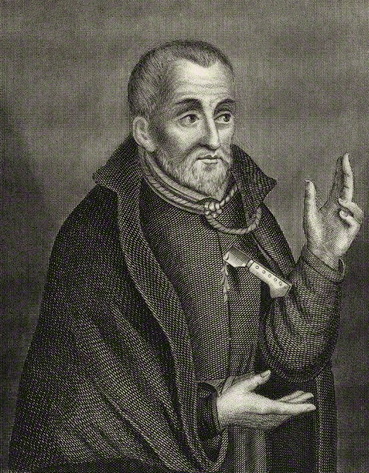
Edmund Campion was a London cloth-merchant's son whose extraordinary academic brilliance won him scholarships at St. John's College, Oxford, where he graduated MA in 1564 and was chosen at twenty-six to deliver the formal Latin address before Queen Elizabeth I on her royal visit to Oxford in 1566 — a performance so dazzling that she predicted (and arranged) his future as a leading English ecclesiastic. He was ordained an Anglican deacon in 1568 but, troubled in conscience, refused the priest's orders and travelled in 1572 to Douai and then to Rome, where he entered the Society of Jesus.
After Jesuit training in Bohemia and Moravia he was sent back to England in June 1580 as part of the first Jesuit mission to England, with Robert Persons (who became its leader on the Continent side) and Ralph Emerson. He travelled in disguise from house to house for fifteen months, ministering to scattered recusant Catholic families, hearing confessions, saying Mass. In 1581 he published his famous Decem Rationes ('Ten Reasons') — a Latin pamphlet challenging Anglican divines to public theological debate — which was illegally distributed at the Oxford Encaenia commencement (June 27, 1581), causing a sensation.
He was captured at Lyford Grange in Berkshire on July 17, 1581, paraded through London with the sign 'Campion, the seditious Jesuit' tied to his arms, racked four times in the Tower (the last so severely that his arms were permanently disabled), confronted in three public debates with Anglican divines while still crippled from the rack, and finally convicted of treason on perjured evidence at Westminster Hall on November 20. On December 1, 1581, with the priests Ralph Sherwin and Alexander Briant, he was dragged to Tyburn, hanged, cut down alive, disembowelled, beheaded, and quartered. His final words: 'In condemning us, you condemn all your own ancestors — all the ancient priests, bishops, and kings.' Canonized 1970.