
MIRACULOUS MIRACLES™

Saint — Edward the Martyr

St. Edward the Martyr
c. 962 AD, Wessex (royal palace of King Edgar the Peaceful) — March 18, 978 AD, Corfe Castle, Dorset (murdered by retainers of his stepmother Queen Ælfthryth)
King of the English 975–978; martyred by his stepmother at the age of 16
Brookwood Cemetery (Orthodox Brotherhood of St. Edward the Martyr), Surrey, England — his relics translated there in 1984 in continuous Orthodox veneration; medieval shrine was at Shaftesbury Abbey, Dorset (destroyed at the Reformation), United Kingdom
Feast
March 18; June 20 (translation 980); also February 18 (translation of relics 2001)
Canonized
Pre-congregation; canonized in 1001 by Pope John XVII at the request of King Æthelred
✠ MartyrStabbed to death at Corfe Castle → The Martyrs
Life

Edward was born around 962 to King Edgar the Peaceful and Queen Æthelflæd Eneda — the great-great-grandson of Alfred the Great. On his father Edgar's death in 975, the succession was contested between Edward (eldest son, age 13) and the younger Æthelred (son of Edgar's second wife Queen Ælfthryth, age 9).

The succession dispute divided the English Catholic episcopate: Archbishop Dunstan of Canterbury, Oswald of Worcester, and the reformist Benedictine party supported Edward; the anti-reform party of secular clergy and the queen-mother Ælfthryth supported Æthelred. Edward was crowned at Kingston upon Thames in summer 975 by Dunstan — the reformist Benedictine settlement.

On the evening of March 18, 978, the 15-year-old (per some sources 16-year-old) King Edward rode to the royal residence of his stepmother Queen Ælfthryth and his stepbrother Æthelred at Corfe Castle in Dorset. Refused entry into the hall, he was given a cup of mead at the saddle by retainers of his stepmother — and as he drank, was stabbed in the back and fell from the saddle, his foot caught in the stirrup; the horse dragged the dying boy across the ground before he was killed.

His body was hastily buried at Wareham; in 980, after the reports of miracles at the tomb, Archbishop Dunstan and Ealdorman Ælfhere translated the relics to Shaftesbury Abbey in Dorset (the Benedictine women's abbey founded by King Alfred). The shrine at Shaftesbury became one of the principal pilgrim destinations of medieval England.

In 1001, at the request of his stepbrother King Æthelred (now reigning as Æthelred the Unready, who repented of the murder of his older brother), Pope John XVII canonized Edward as martyr — the martyr-king tradition of the late-Anglo-Saxon Catholic English kingdom.

Miracles & Phenomena
  • The miraculous translation of 980 and the Shaftesbury shrine

    The hasty initial burial of Edward at Wareham in March 978 was followed by reports of miracles at the tomb — healings, sightings of lights — that prompted Archbishop Dunstan and Ealdorman Ælfhere to translate the relics to the Shaftesbury Abbey in 980 with royal ceremony. The Shaftesbury shrine became one of the principal pilgrim destinations of medieval England, surviving until the dissolution of Shaftesbury Abbey in 1539 under Henry VIII.

  • The recovery and translation of the relics (1931, 1984)

    In 1931, archaeological excavations at the ruins of Shaftesbury Abbey recovered bones identified as those of St. Edward the Martyr. After decades of Anglican-Catholic-Orthodox dispute over their disposition, the relics were translated in 1984 to the Orthodox Brotherhood of St. Edward the Martyr at the Brookwood Cemetery in Surrey (a ROCOR community), where they remain in continuous Orthodox liturgical veneration. The Catholic Diocese of Plymouth and the Anglican Diocese of Salisbury preserve the pilgrim tradition at the ruins of Shaftesbury Abbey.

Relics
  • Body
    Relics of St. Edward the Martyr
    Brookwood Cemetery, Surrey, England — Orthodox Brotherhood of St. Edward the Martyr (ROCOR shrine); the medieval shrine at Shaftesbury Abbey, Dorset, was destroyed at the 1539 dissolution

    His principal relics are venerated today at the Orthodox Brotherhood of St. Edward the Martyr at the Brookwood Cemetery in Surrey, England. The ruined Shaftesbury Abbey survives as a picturesque medieval ruin and pilgrim destination.

Iconography
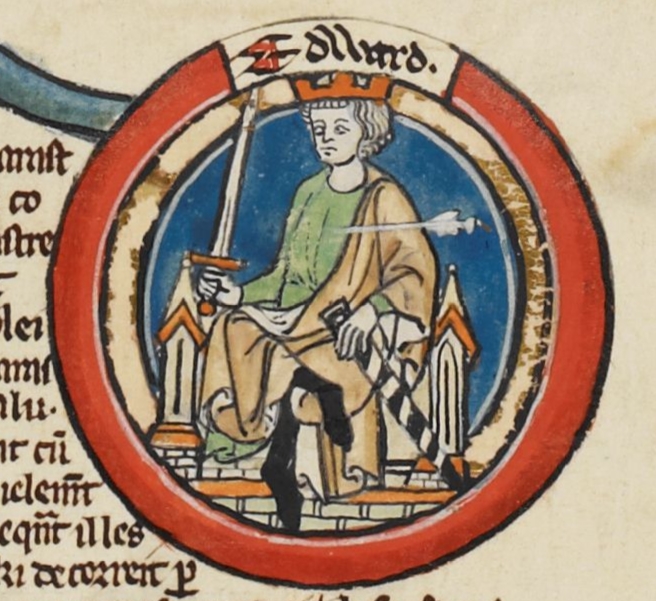
  • Edward the Martyr at the Corfe Gate

    The young Anglo-Saxon king in royal-warrior dress at the gate of Corfe Castle on the evening of March 18, 978, receiving the cup of mead from the hand of his stepmother's retainer, the dagger raised behind him to strike — the iconography of Anglo-Saxon Catholic martyr-king tradition.

Patronages
Catholic Anglo-Saxon Catholic martyr-king traditionCatholic victims of family treacheryShaftesbury (Dorset) and the English Reformation-period Catholic recusant traditionCatholic young royal saints (martyred at age 16)