
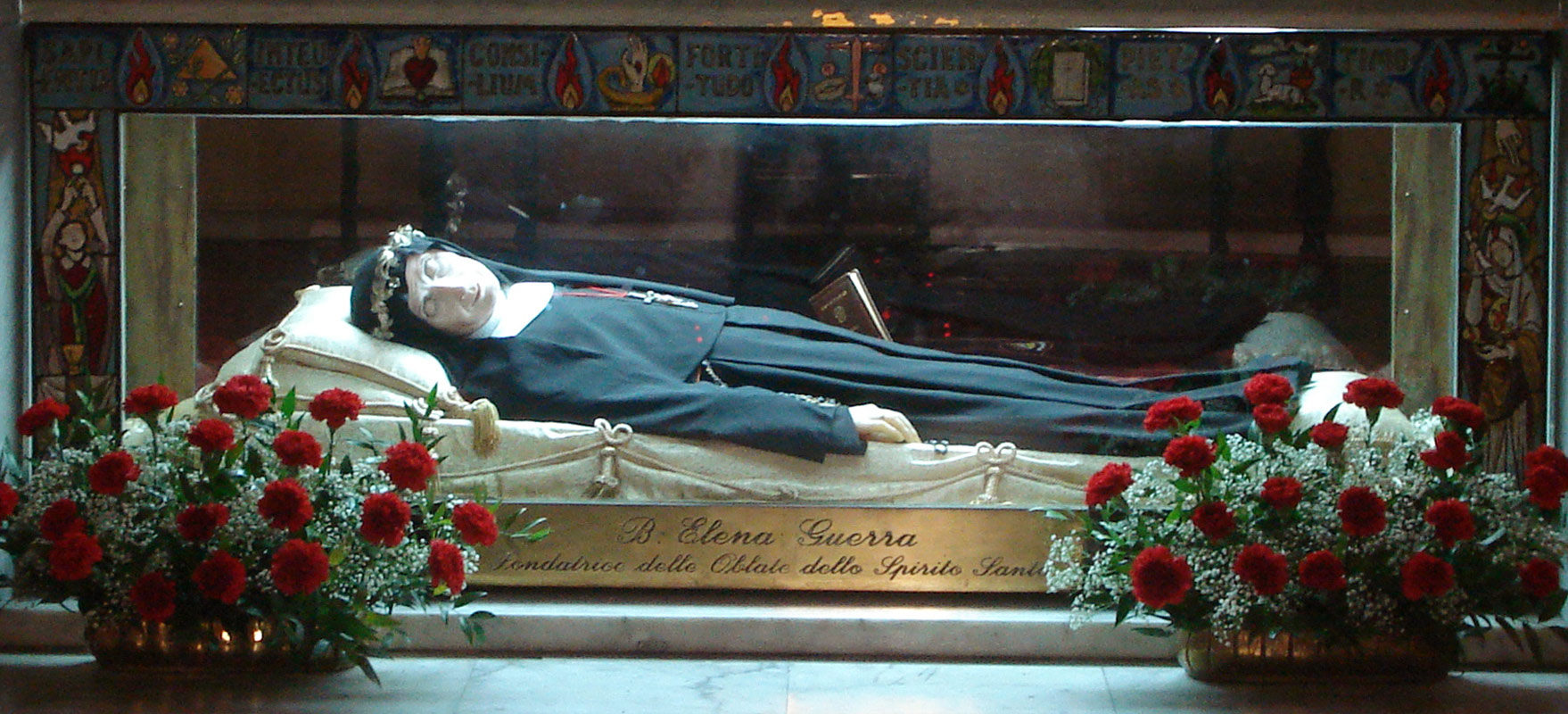
Elena Guerra was born in Lucca on June 23, 1835 to Antonio Guerra and Faustina Franceschi, a devout family of small nobility. Confirmed on June 5, 1843, a few days short of eight, she said afterwards that a devotion to the Holy Spirit came to her then on its own, with nobody teaching it. She made her First Communion the next year and obtained, unusually for the time, leave to receive daily. Kept from serious schooling as a girl, she taught herself Latin at night from her brother Almerigo's books and read the Fathers of the Church.
In 1856 she founded two associations for young women, the 'Giardinetto di Maria' and the 'Amicizie spirituali', in which girls helped one another to live the faith seriously — a method the Dicastery notes anticipated Catholic Action. A long illness left her bedridden; when she recovered she joined the Ladies of Charity and visited the poor and sick in their homes, and went on doing so when cholera broke out in Lucca. A pilgrimage to Rome with her father, and the sight of Pius IX, settled her vocation to the Church.
In December 1872 she opened a school for the daughters of Lucca's better families, which became the Institute of St. Zita. A small, sickly pupil who passed through it was Gemma Galgani. In 1882 Elena and her companions began common life, and the Archbishop of Lucca recognised them as the Oblates of the Holy Spirit — the Lucchese still call them the Suore di Santa Zita.
Her one message was that the Church should return to the Upper Room. She founded the 'Cenacolo permanente', a union of prayer for the Holy Spirit, wrote pamphlet after pamphlet, and between 1895 and 1903 wrote letter after letter to Leo XIII asking him to make the days before Pentecost a novena for the whole Church. He did. The brief Provida matris caritate of May 5, 1895 ordered the Pentecost novena in every diocese; the encyclical Divinum illud munus of May 9, 1897, the first papal encyclical on the Holy Spirit, followed; and in 1902 the letter Ad fovendum in christiano populo renewed the call. Leo XIII encouraged her personally.
The last years were a humiliation. In 1905–1906 some of her own sisters accused her of mismanaging the institute's money; the archbishop required her to resign as superior and forbade her to publish. She obeyed without a word of protest, writing that to stay firm against one's own will, hands bound and without rebellion, was a higher work than any she had planned. After three years of poor health she died on Holy Saturday, April 11, 1914, her last word 'Credo'.
Pius XII declared her virtues heroic on June 26, 1953 and John XXIII beatified her on April 26, 1959, the first beatification of his pontificate, calling her an apostle of devotion to the Holy Spirit. Her body, moved in 1928 to the Oblates' church of Sant'Agostino in Lucca, lies there under the altar in a glass case. Pope Francis authorised the decree on the canonisation miracle on April 13, 2024 and canonised her in St. Peter's Square on October 20, 2024, the Catholic Charismatic Renewal, which had adopted her as a patron, filling the square.