
MIRACULOUS MIRACLES™

Saint — Elisabeth of Schönau

St. Elisabeth of Schönau
1129 AD, Rhineland (German Catholic noble family) — June 18, 1164 AD, Schönau Abbey, near St. Goarshausen, Rhineland
German Benedictine visionary; Rhineland mystic; younger contemporary and correspondent of St. Hildegard of Bingen
Schönau Abbey (Kloster Schönau im Taunus), near St. Goarshausen, Rhineland-Palatinate, Germany — her monastic home; the pilgrim destination preserving her shrine, Germany
Feast
June 18
Canonized
Pre-congregation; entered into the Roman Martyrology under Pope Sixtus V in 1584
Life

Elisabeth was born in 1129 to a German Catholic noble family of the Rhineland. At age 12 (in 1141) she was given as a child oblate to the Benedictine double-monastery of Schönau im Taunus — under the governance of the Benedictine community of Schönau in the Rhineland mountains near St. Goarshausen.

She took the Benedictine vows at the age of 18 (1147) and became magistra of the women's community at Schönau around 1157. Her paternal half-brother Egbert would subsequently become Abbot of Schönau (1166–1184) — and the close spiritual-and-familial collaboration between Elisabeth and Egbert produced the principal literary collection of her mystical writings.

Beginning in 1152, Elisabeth experienced a series of ecstatic visions and angelic visitations — documented by her brother Egbert in three principal collections: the Liber Visionum (Book of Visions), the Liber Viarum Dei (Book of the Ways of God), and the Liber Revelationum de Sacro Exercitu Virginum Coloniensium (Book of Revelations on the Sacred Army of the Virgins of Cologne) — the principal hagiographical-elaboration of the legend of St. Ursula and the eleven thousand virgins of Cologne (a substantial late-12th-century development of the original 4th-century cult of Ursula).

Her visionary writings circulated widely in the medieval Catholic mystical-literary tradition — over 150 surviving medieval manuscripts of the Liber Visionum, one of the most widely-copied medieval women's mystical texts.

Most personally, Elisabeth maintained a substantial correspondence with St. Hildegard of Bingen (1098–1179, her elder contemporary, the principal Rhineland visionary of the 12th century) — producing the deep spiritual-correspondence friendship between the two principal Rhineland women mystics of the High Medieval period. Hildegard counselled Elisabeth on the question of the extreme visionary-ecstatic experiences and the temptations of visionary self-importance.

Elisabeth died at Schönau on June 18, 1164, at the age of 36. Her name was entered into the Roman Martyrology under Pope Sixtus V in 1584, institutionally confirming her immemorial Rhineland Catholic cult.

Miracles & Phenomena
  • The Liber Viarum Dei and the Rhineland-mysticism tradition

    Elisabeth of Schönau's mystical-visionary writings — most the Liber Visionum, the Liber Viarum Dei, and the Liber Revelationum de Sacro Exercitu Virginum Coloniensium — produced one of the principal corpora of medieval women's mystical-theological literature. The visionary texts institutionally influenced the Rhineland-mysticism tradition of Sts. Mechthild of Magdeburg (1207–1282), Gertrude the Great (1256–1302), Mechthild of Hackeborn (1241–1298), Master Eckhart (1260–1328), Henry Suso (1295–1366), and Johannes Tauler (1300–1361) — the principal Catholic mystical tradition of the High and Late Medieval German-Catholic culture.

  • The correspondence with St. Hildegard of Bingen

    Elisabeth of Schönau's substantial correspondence with St. Hildegard of Bingen (1098–1179, her elder contemporary) — producing the deep spiritual-correspondence friendship between the two principal Rhineland women mystics of the High Medieval period — is one of the principal documented medieval women's spiritual-friendship correspondences. The Hildegard-Elisabeth correspondence illustrates the distinctive Catholic recognition and mutual spiritual-discernment between the two principal contemporary Rhineland visionaries.

Relics
  • Body
    Tomb of St. Elisabeth of Schönau
    Schönau Abbey (Kloster Schönau im Taunus), near St. Goarshausen, Rhineland-Palatinate, Germany — the shrine survives

    Her tomb at the Schönau Abbey survives in the abbey-church (restored in centuries). The abbey is a pilgrim destination of the Rhineland Catholic tradition.

Iconography
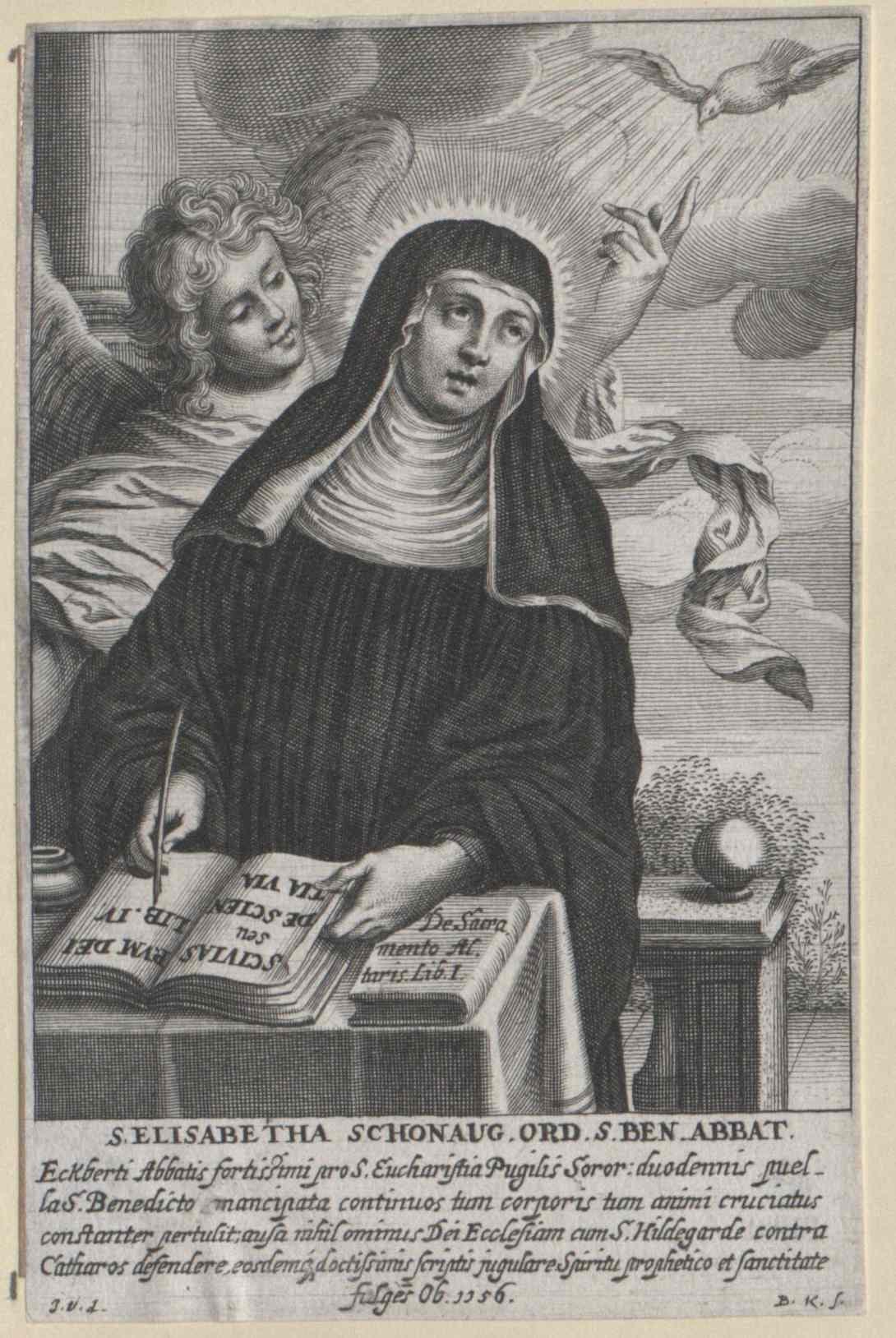
  • Elisabeth of Schönau dictating visions to her brother Egbert

    The mid-12th-century German Benedictine visionary in Benedictine habit at the Schönau Abbey dictating her ecstatic visions to her brother Egbert (future Abbot of Schönau), the liturgical-mystical Latin text being written down on the parchment — the iconography of Catholic German Rhineland women's-visionary-mystical tradition.

Patronages
Catholic German Rhineland mystical tradition (with St. Hildegard of Bingen and the Rhineland-mysticism tradition of Sts. Mechthild of Magdeburg, Gertrude the Great, Mechthild of Hackeborn, Master Eckhart, Henry Suso, Johannes Tauler)Catholic visionary writers and mystic-correspondents (her correspondence with Hildegard)The Rhineland-Palatinate Catholic tradition (Schönau, Bingen, St. Goarshausen)