
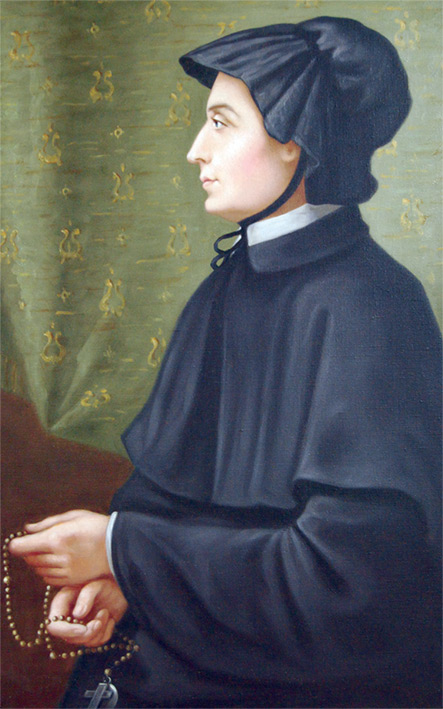
Elizabeth Ann Bayley was born in colonial New York City three years before American independence, the daughter of a prominent Episcopalian physician. At nineteen she married William Magee Seton, a wealthy shipping merchant; over ten years they had five children. By 1803 William's business had collapsed and he was dying of tuberculosis. They sailed to Italy hoping the climate would help; he died there in December 1803, leaving her a thirty-year-old widow with five children in a foreign country.
During the months she spent with the Filicchi family of Livorno before sailing home, she was drawn to Catholicism. On returning to a hostile Episcopalian New York in 1805, she was received into the Catholic Church — and instantly cut off by her family, society, and most of her former friends. To support her children she opened a boarding school, which failed because no Protestant family would send their daughters to a 'papist' widow.
In 1809 she moved to Emmitsburg, Maryland, and there founded the Sisters of Charity of St. Joseph's — the first apostolic order of women established by an American, and the seed of the entire American Catholic school system. She wrote the rule, trained the first sisters, ran the school for poor children, nursed the sick, and bore the deaths of two of her own daughters from tuberculosis. She herself died of the same disease at forty-six.
From her one foundation came the Sisters of Charity of New York, Cincinnati, Halifax, Convent Station, Greensburg, and Seton Hill — and through them, hundreds of Catholic hospitals and thousands of Catholic schools across North America. She is honored as the foundress of the American parochial school system.