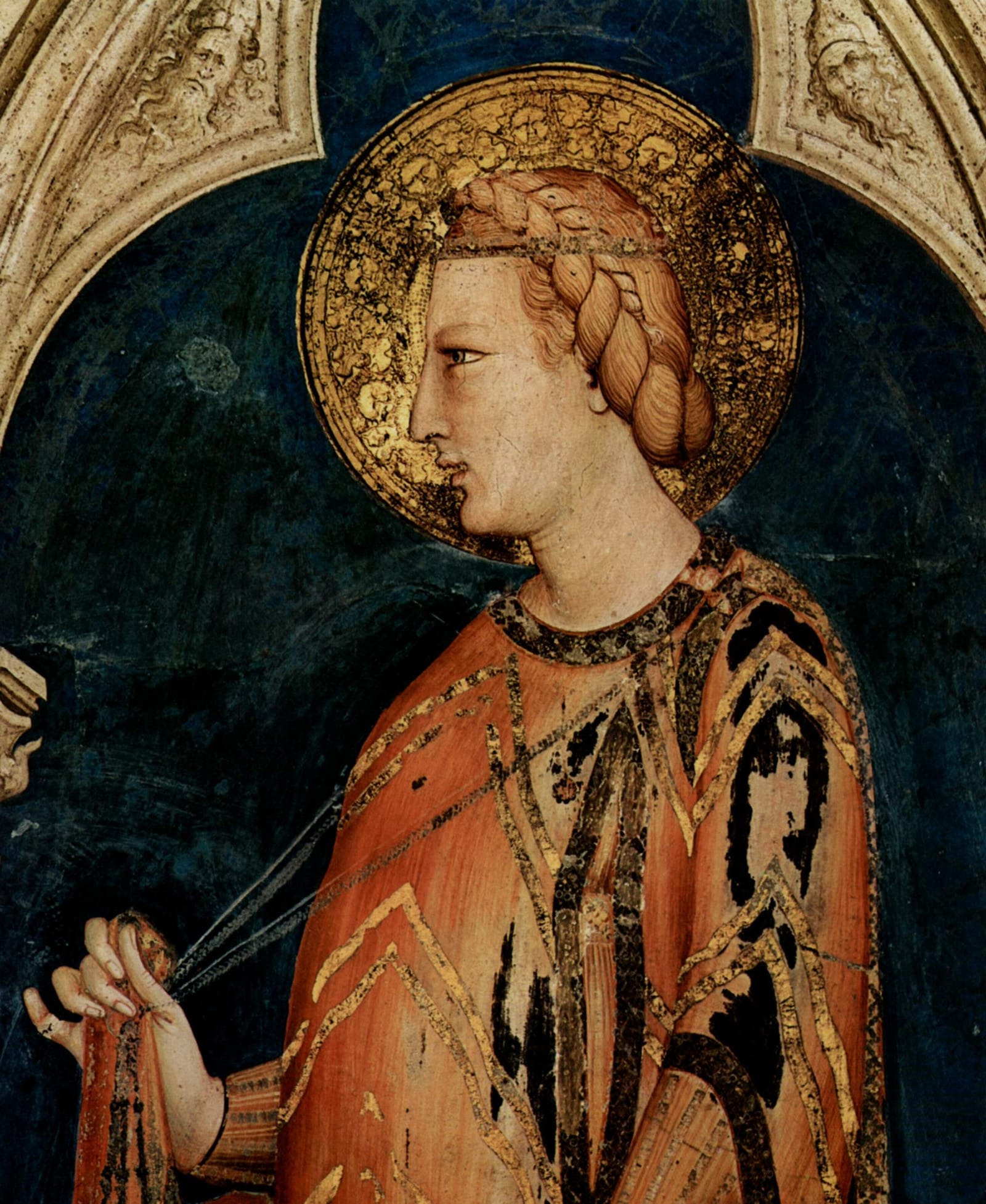
Elizabeth was the daughter of King Andrew II of Hungary and Gertrude of Andechs-Merania. At four she was betrothed to Ludwig of Thuringia and sent to be raised at the German court at the Wartburg castle. They were married in 1221, when she was fourteen and he twenty-one, and by all accounts loved each other passionately. They had three children.
Ludwig encouraged her growing devotion. Under the direction of the Franciscan Conrad of Marburg, she fed the poor of Thuringia from the castle stores during the great famine of 1226, built a hospital at the foot of the Wartburg, and personally bathed and nursed the lepers no one else would touch. Ludwig, who had taken the cross for the Sixth Crusade, died of fever at Otranto in September 1227. Elizabeth was twenty.
Cast out of the Wartburg by her brother-in-law, she sold her last possessions, took the grey habit of the Franciscan Third Order (the first woman north of the Alps to do so), and built a new hospital at Marburg dedicated to St. Francis. She nursed the dying with her own hands until her body, never strong, gave out at twenty-four. Canonised four years later by Gregory IX. The vast Gothic Elisabethkirche of Marburg, built 1235–83, is the first true Gothic church in the German lands and the prototype of the German Gothic.
The Miracle of the Roses
Carrying bread in her cloak to the poor against the prohibition of her hostile sister-in-law Sophia, Elizabeth was stopped by her husband Ludwig. He demanded to see what she was hiding. She opened her cloak — and the loaves had turned to red and white roses. (A devotional legend with no contemporary documentary source, but the defining iconographic moment of her cult.)
The Leper in the Royal Bed
Tradition: Elizabeth, finding a leper without shelter, brought him into the Wartburg and laid him in her own bed. When her mother-in-law in fury opened the curtains to denounce her, the figure in the bed was the crucified Christ. (Devotional tradition, but central to the saint's iconography.)
Founding of the Marburg Hospital
After her widowhood she sold her last possessions in 1228 to found a hospital at Marburg dedicated to St. Francis — one of the earliest Franciscan hospitals north of the Alps. She herself worked there as a nurse until her death three years later.
Healings at the Tomb (canonization miracles)
After her death the documented healings at her tomb at Marburg were collected — 130 attested cures formed the basis of the canonisation process that concluded in 1235. The cures included the restored sight of the blind, healed paralytics, and several reported resurrections of small children.
Sources & Further Reading