
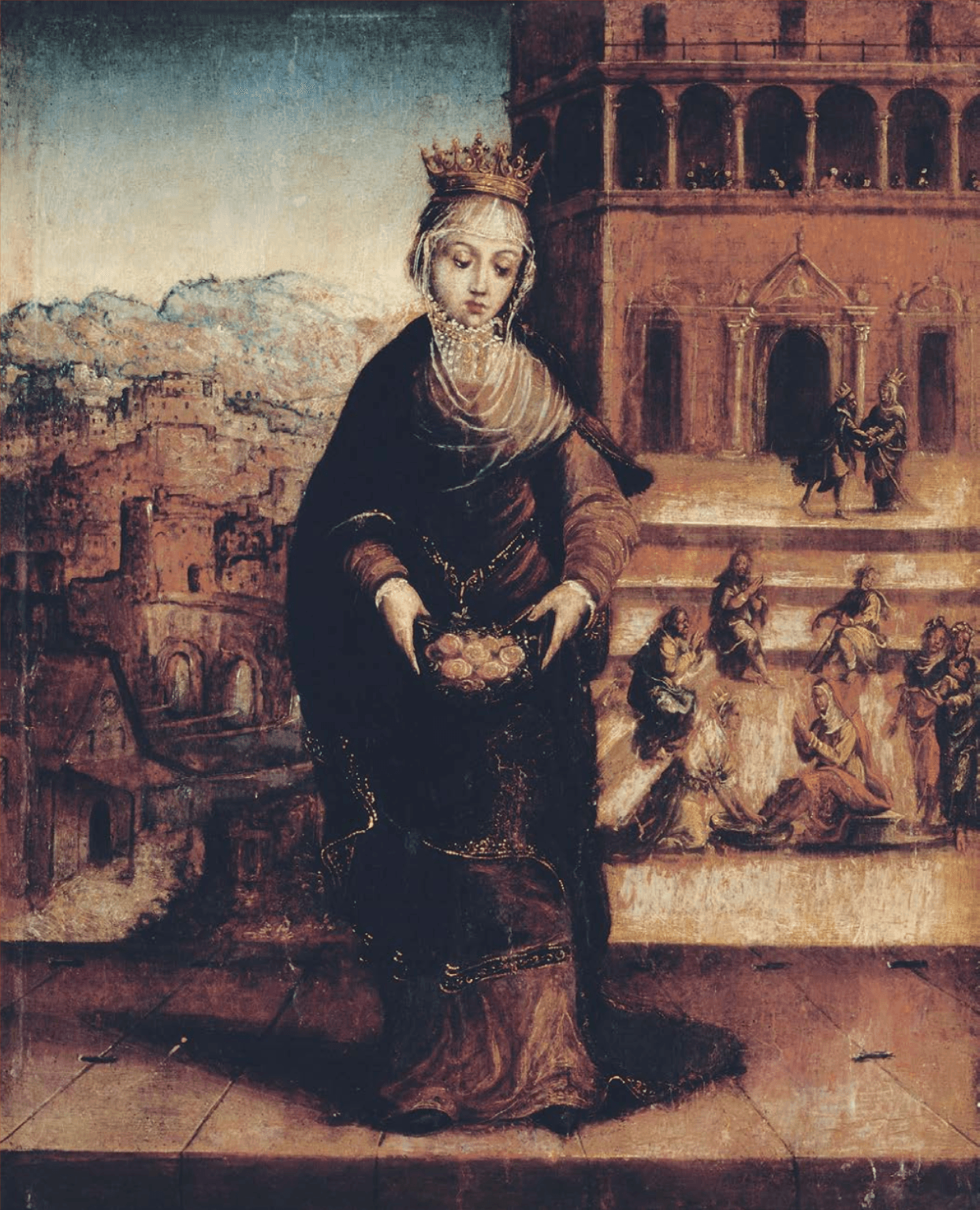
Elizabeth was named for her great-aunt Elizabeth of Hungary and was the daughter of King Peter III of Aragon. Married at twelve to the difficult King Denis I of Portugal, she lived a life of patient endurance: Denis's flagrant infidelities (he had at least seven illegitimate children whom Elizabeth raised alongside her own two), his political quarrels with both her sons and with their brothers and cousins in Castile and Aragon, and the constant threat of dynastic civil war.
Her central public work was peacemaking. Three times she rode out personally between opposing armies — most famously at Alvalade in 1323 between her son the future Afonso IV and her husband King Denis — and brought about reconciliation. After Denis's death in 1325 she took the Franciscan tertiary habit, established her residence at the convent of Santa Clara in Coimbra (which she founded and richly endowed), and lived twelve years of religious retreat broken only by further peacemaking missions.
In 1336 her son Afonso IV was at war with his son-in-law Alfonso XI of Castile. Now sixty-five, Elizabeth rode south to mediate, fell ill on the journey at Estremoz, and died there on July 4. She was buried at Santa Clara in Coimbra in her Franciscan habit. The miraculous flowers — gold coins she was distributing to the poor that became roses in her apron when her husband suspiciously demanded to see what she was carrying — became the central element of her iconography. Canonized in 1625, she is one of the principal patrons of Portugal alongside St. Anthony of Padua.