
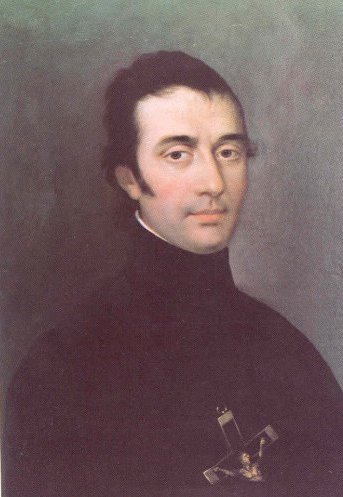
Charles Joseph Eugène de Mazenod was born to a Provençal aristocratic family at Aix-en-Provence and spent his childhood (1791–1802) in exile in Italy during the French Revolution and Empire (his father had been a magistrate of the ancien régime Aix Parliament). Returning to Provence under Napoleon, he experienced a profound conversion at Aix Good Friday 1807 at twenty-five, entered the seminary of Saint-Sulpice in Paris in 1808, and was ordained priest at Amiens in December 1811.
He founded in 1816 — at the Mission House of Aix-en-Provence — a small congregation of priests for the systematic parish-mission preaching of the post-Napoleonic French rural Catholic restoration. The original 'Missionaries of Provence,' deliberately speaking the Occitan dialect of the Provençal Catholic peasantry, conducted parish missions across Provence and the Languedoc through the 1820s. In 1826 the congregation was approved by Pope Leo XII with a new name: the Missionary Oblates of Mary Immaculate (Oblats de Marie Immaculée, OMI). Mazenod was named Bishop of Marseille in 1837 and served as bishop (later Archbishop) of the see for the remaining twenty-four years of his life.
Under his direction the Oblates grew rapidly into the principal French missionary congregation of the 19th century. They established (from 1841 onwards) the great Catholic missions to the indigenous peoples of Canada — Métis communities of Manitoba and Saskatchewan, the Dene of the Mackenzie River basin in the Northwest Territories, the Inuit of the Arctic coast — making the Oblates the principal Catholic missionary congregation to the indigenous peoples of the Canadian North through the 19th and 20th centuries. They simultaneously established the Catholic missions to Ceylon (modern Sri Lanka, from 1847), South Africa (from 1851 — see the Lesotho mission of François Allard OMI), and Australia (from 1894 — the missions of the Kimberley region).
Mazenod also built the new Cathedral of Marseille (begun 1852, finished by his successors 1893) and was a central figure of the early ultramontane French Catholic movement that helped prepare the 1854 Immaculate Conception definition by Pius IX. He died at Marseille on May 21, 1861. Canonized 1995 by John Paul II — the principal Catholic missionary-bishop saint of the 19th century. The historical Oblate role in the Canadian Indian residential school system (1880s–1990s) — which has been the subject of major Catholic-Canadian reckoning since the 2008 Truth and Reconciliation Commission — has produced sustained ongoing Oblate institutional examination, including Pope Francis's July 2022 'penitential pilgrimage' to Canada and direct apology to Indigenous communities.