
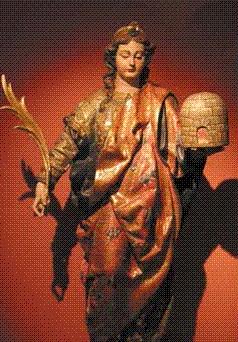
Eulalia (Greek Eulalia, 'sweet-speech') was — per the Iberian Catholic tradition preserved in the famous Latin Peristephanon hymn of the late-4th-century Spanish-Roman Christian poet Prudentius — a young Spanish-Roman girl of about twelve years of age in the late 3rd century, from a noble family of Mérida (the Roman provincial capital of Lusitania, then the principal city of western Hispania).
When the Diocletianic edicts of 303 reached Mérida and the Roman provincial governor Calpurnianus began the local enforcement, the twelve-year-old Eulalia — without her parents' knowledge — secretly escaped from her family villa, walked to the provincial governor's tribunal, and publicly denounced him for participating in the persecution of Christians. Astonished, the governor attempted first persuasion (promising her marriage to a noble youth), then physical intimidation, then torture. Eulalia under torture is described by Prudentius spitting at the governor and breaking the small pagan-libation idol he had set before her for the formal recantation-test. She was finally killed by being burned alive at the stake; the smoke from the pyre was said to have ascended in the form of a dove from her mouth, and a sudden snowfall covered her body — the foundational iconographic emblems of her cult.
Prudentius's Peristephanon hymn — composed within a century of her death and based on still-living Mérida liturgical tradition — is the foundational Spanish-Latin literary witness. Her cult became one of the great foundational Iberian Catholic cults. Her body was translated from Mérida to Oviedo in 812 by King Alfonso II of Asturias during the Reconquista to protect the relics from the advancing Muslim conquest. They remain at Oviedo Cathedral.