
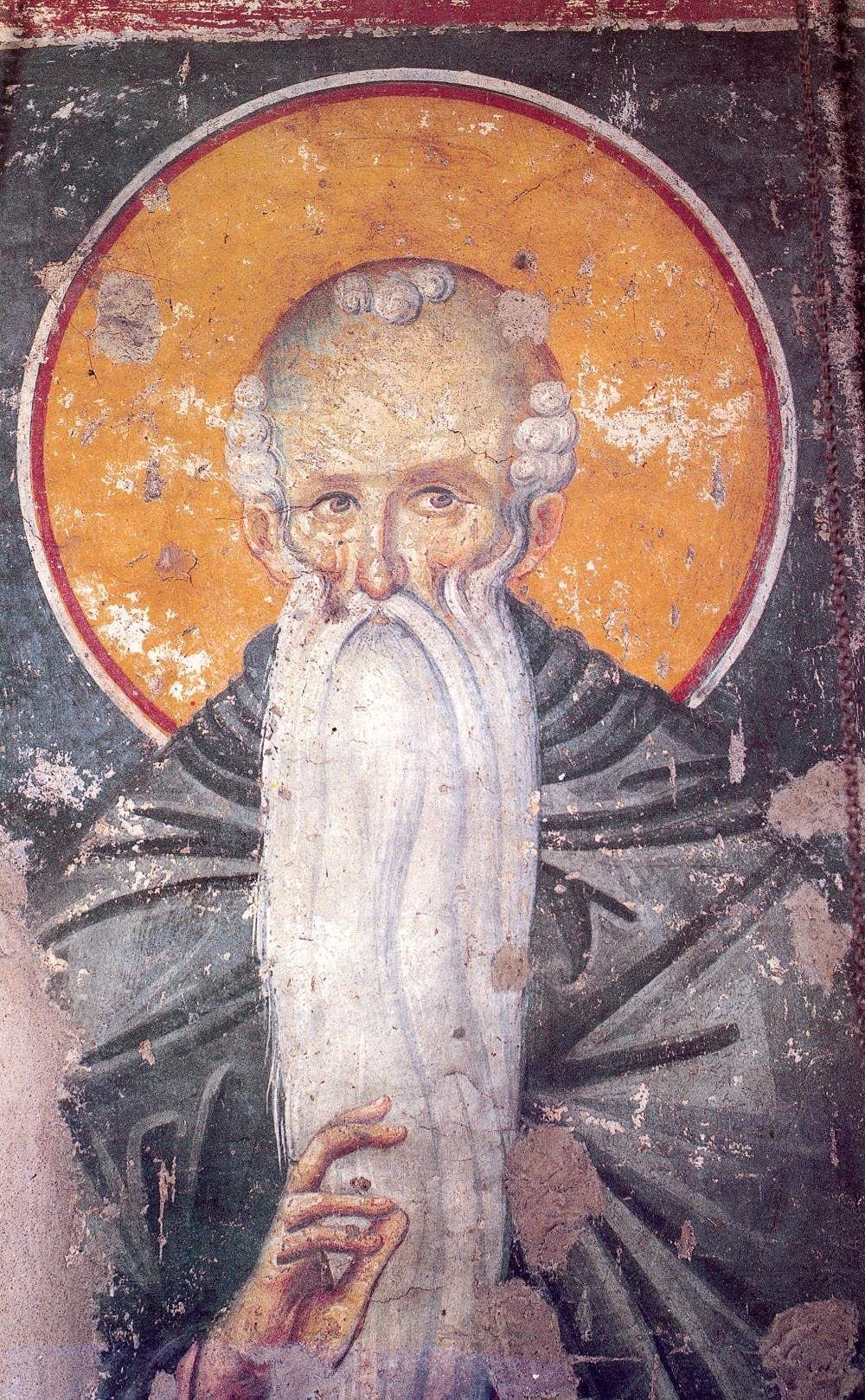
Euthymius (Greek Euthymios, 'cheerful') was — per the contemporary biography by his disciple Cyril of Scythopolis (composed c. 555 AD), one of the most historically reliable of all 5th-century saint's lives — a young Armenian Christian of Melitene who was raised by his widowed mother in a substantial monastic-educational environment. He undertook the long Eastern Mediterranean ascetic pilgrimage to the Holy Land at about 29 years of age, around 406 AD.
He settled at the Palestinian-monastic community at Pharan in the Judean Desert about ten kilometres east of Jerusalem, but soon withdrew with his companion Theoctistus to a small cave in the deeper desert about ten further kilometres east of Pharan. The cave-community grew rapidly into a substantial monastic community — Theoctistus governing the cenobitic-community core (the koinobion, for less-experienced monks) and Euthymius the dispersed lavra-community of older hermit-monks (the lavra — Greek for 'lane' or 'alley' — referring to the dispersed pattern of individual hermit cells along the deep wadi-canyon paths around a central liturgical chapel).
Euthymius's foundational historical importance is twofold. First, he established the foundational architectural and disciplinary model of the Palestinian-lavra monastic tradition — the distinctive Palestinian organizational form in which an experienced abbot-spiritual-father supervised a dispersed community of individual hermit-monks who gathered for common liturgy only on weekends. The Palestinian-lavra model would become the dominant form of monastic life in the Eastern Christian tradition through the entire medieval period and would influence (through the Athonite tradition and the Russian-Orthodox skete tradition) all subsequent Eastern Christian monasticism. His own Lavra of Euthymius — founded around 428 — was the foundational example and the model for all subsequent Palestinian lavras (including the Great Lavra of St. Sabas, founded a generation later by Euthymius's grandpupil Sabbas — see Sabbas's entry in the 6th-c. supplemental catalogue, when we do the 6th-c. supplement).
Second, Euthymius was a major figure of the post-Chalcedonian Christological clarification in Palestine. He was personally consulted by the Empress Eudocia (see Eudocia's entry below) during her long retreat in Palestine; his theological direction was substantially responsible for her eventual acceptance of the Chalcedonian definition. He died on January 20, 473, at about 95 years of age. His tomb at the Lavra of Euthymius (modern Khirbet el-Khan in the Judean Desert) was the central Palestinian-monastic pilgrimage site from the 5th to the 12th century.