
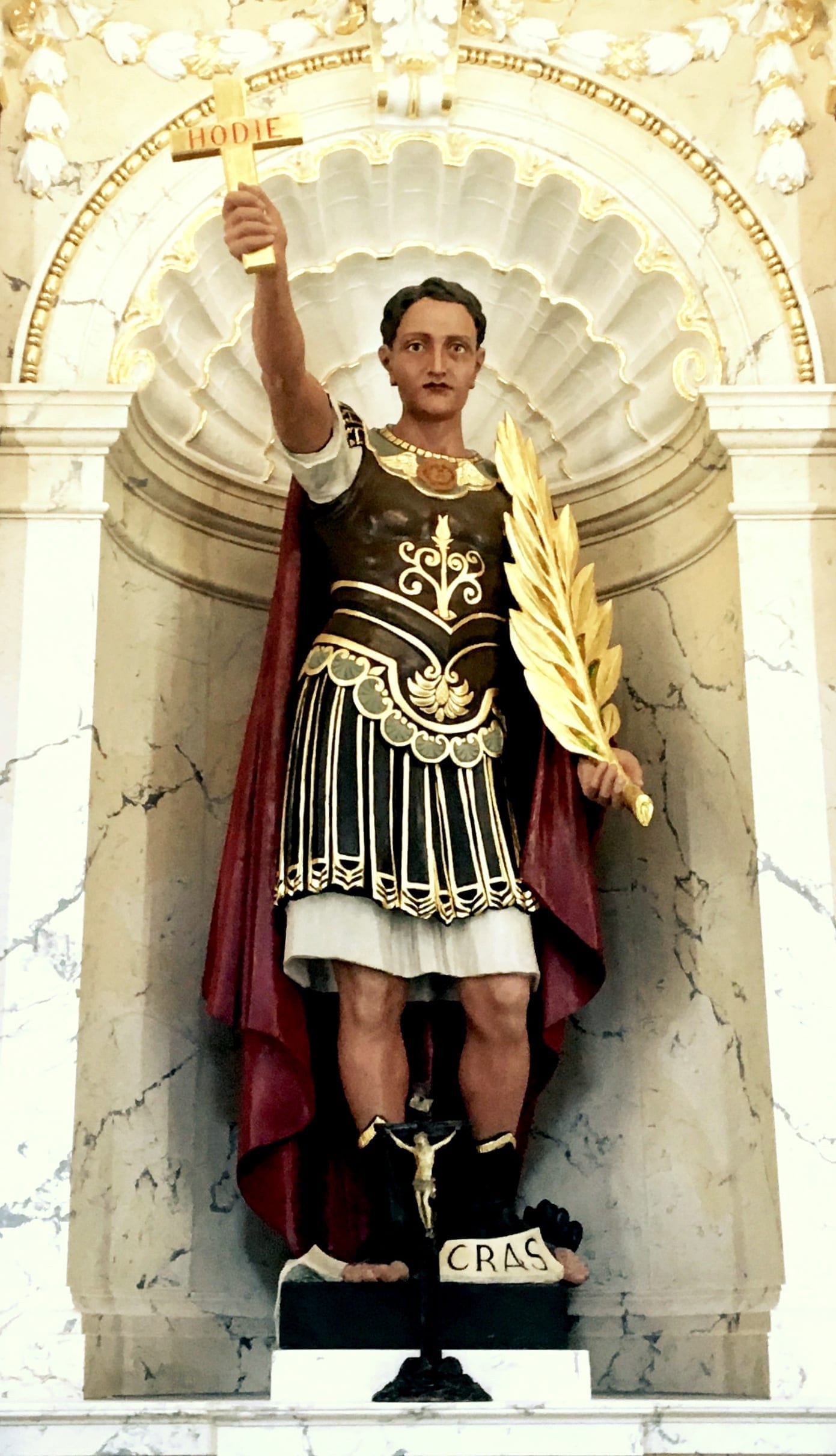
Expeditus appears in the ancient Hieronymian Martyrology among a company of martyrs who died at Melitene in Armenia Minor — by tradition a Roman centurion of the garrison there, beheaded in the great persecution of Diocletian around 303, on April 19. Of his life nothing further is recorded; like many soldier-martyrs of the eastern legions, he survives as a name, a place, and a death for Christ.
His extraordinary later cult grew from his providential name. Expeditus is Latin for 'unencumbered, ready, swift' — the expediti were light-armed soldiers who could move at once. Popular devotion made him the natural enemy of delay: the saint to invoke when time has nearly run out, and the patron against the procrastinating word that ruins souls — 'tomorrow.'
His iconography preaches the sermon: a young Roman soldier holding up a cross inscribed HODIE ('today'), his foot crushing a crow croaking CRAS ('tomorrow' — in the legend, the devil in crow form urging him to put off his conversion). A widely repeated tale that his cult began when a crate of relics marked spedito ('expedited') was mistaken for a saint's name is itself a legend — his name stands in martyrologies centuries older than the story. Shown for both sides, per the source policy: because so little history survives, his feast has never entered the universal calendar, and some scholars regard the person as unverifiable; the Church tolerates a cult that popular faith has made enormous.
Devotion to St. Expeditus today is strongest far from Melitene: he is among the most invoked saints of Réunion (where roadside shrines to him are painted red), of Brazil (where his April 19 feast fills churches in São Paulo with hundreds of thousands), of the Philippines, and of New Orleans, where the statue in Our Lady of Guadalupe church has carried the devotion since the nineteenth century.